Average response time: under 24 hours
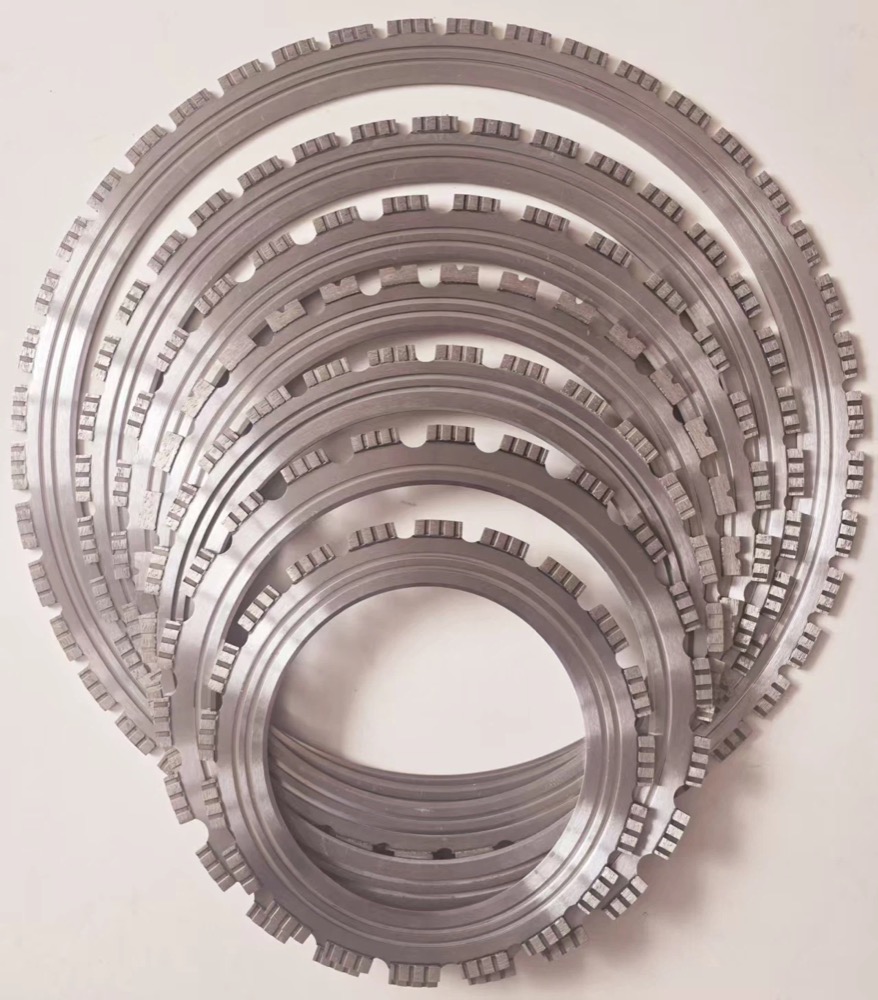
Cut curves and circles in concrete by first marking the line, then using a ring saw for tight radii, a walk-behind saw with a pivot for long arcs, or a diamond wire saw for large openings such as floor drains and manholes. Never force a circular saw around a curve — it binds, wanders, and chips the edge. A pilot hole at the start and a shallow starter cut keep the blade on line.
| Cut shape | Best tool | Why |
|---|---|---|
| Tight radius, small circle (10–40 cm) | Ring saw | Open center starts inside a hole; thin rim follows curves |
| Medium arc, straight start plus curve | Handheld saw with pivot guide | Cheaper; you control feed direction |
| Long shallow arc (joints, curbs) | Walk-behind floor saw | Weight and stability; good depth control |
| Large opening (60 cm+), rebar | Diamond wire saw | No blade-diameter limit; cuts rebar cleanly |
The ARIX Ordered-Segment Diamond Ring Saw Blade (JOY-ARX-RS) is the go-to tool for interior circular work: its open center drops over a pilot hole, and the ordered segments keep it true on tight turns.
For arcs longer than a meter, a walk-behind saw on a curved guide rail stays truer than a handheld tool. For large openings with rebar, a Diamond Wire Saw for Concrete — JOY-WS-C removes the section without the diameter limits of a circular blade and cuts through steel cleanly. On straight runs that turn into curves, keep a Concrete and Asphalt Saw Blade (Laser Welded) — JOY-CA-LW ready for the transition, and slow the feed as you enter the arc.
A: For small holes yes, but a ring saw is safer and cleaner: it starts inside the hole without plunge-cutting the whole disk from the surface, and its open center avoids trapping the blade.
A: Just larger than the ring's inner diameter, usually 20–35 mm. Drill it inside the scored line so the blade follows your mark.
A: A diamond wire saw is the practical answer for large reinforced openings. For small circles, a ring saw with welded segments will cut occasional rebar if you slow the feed and keep water on.
A: Yes, within the early-entry window — but use an early-entry saw and keep the arc shallow; green concrete is softer and the blade glazes if you force it.
Curved and circular cuts come down to matching the tool to the radius: ring saw for tight holes, pivot-guided saw for medium arcs, walk-behind for long curves, wire saw for large reinforced openings. Mark carefully, pilot the start, and never twist the blade. With the right setup, openings for drains, manholes, and decorative joints come out true and clean — and the segments keep their full life because the cut stayed in one plane.
Written and reviewed by JOY TECH — an SGS & BV audited, CE/RoHS certified diamond tools manufacturer founded in 2004, exporting to 50+ countries.
Our factory and QMS are audited by SGS and Bureau Veritas. Products meet CE/RoHS requirements and every piece is 100% inspected before packing.
Verified Certificates
