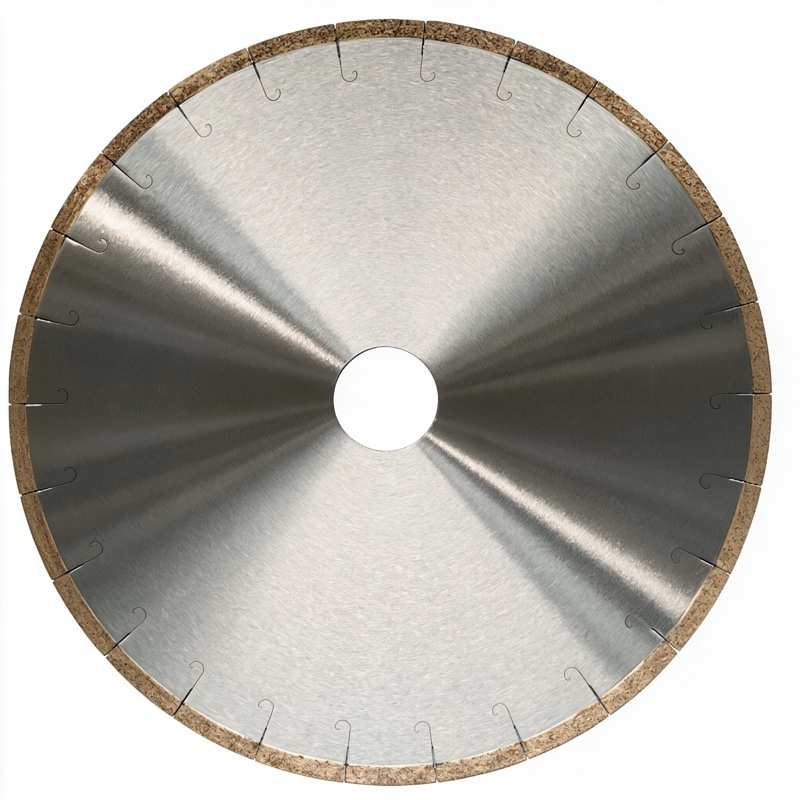
To cut stone tiles on a wet saw, fit a diamond blade matched to the stone (continuous rim for marble, turbo for granite), set the water depth to cover the blade flange, feed the tile steadily into the blade, and keep the glaze side up. Wet cutting cools the blade, suppresses silica dust, and produces chip-free edges that dry cutting cannot match.
Soft stones like marble and travertine need a sharp, thin continuous rim to avoid chipping; our J-slot marble blade clears swarf smoothly. Hard granite and quartzite benefit from a turbo or segmented rim like the straight-slot marble blade for faster cutting. Do not use a concrete blade on polished stone; it will scratch and chip.
Mark the cut on the polished face with a wax pencil. Place the tile polished-side up, align the mark with the blade, and push forward at a steady pace. Do not push the tile back toward the spinning blade. For narrow strips, use a holder or push stick to keep fingers clear. For curves, make relief cuts and nibble away waste.
Most tile wet saws run at 3000-5000 RPM, which is correct for small-diameter blades. If your saw is variable speed, run stone at mid-range; too fast burns soft marble, too slow glazes the blade. Always match the blade's stated RPM range.
Murky, slurry-heavy water cuts poorly because grit recirculates and scratches the tile. Drain and clean the reservoir daily, and top up with clean water. A clean cool flow also extends blade life by keeping the rim free of packed stone dust.
For notches around pipes or fixtures, make a straight cut to the corner, then nibble the waste out with successive short cuts rather than trying to pivot the blade. Stone does not forgive a twist; the blade must travel in a straight line through the cut.
A new stone blade often needs a light break-in cut on soft stone before tackling hard granite. Run the first few cuts slightly slower to seat the diamonds. Rushing a new blade into dense granite can chip brand-new segments.
Clean water, right rim, steady feed. A wet saw turns stone tile cuts into clean, accurate work.
Marble cuts fast and chips easily, so feed steadily but not aggressively. Granite needs a firmer feed to keep the bond wearing. Travertine has voids, so ease through soft patches to avoid breakout. Watch the slurry: milky and even means the blade is happy; clogged or dry means slow down and add water.
Empty and clean the water tray daily. Tighten the blade flange weekly. A dull blade produces a ragged edge faster than operators realize, so swap blades when cuts slow rather than forcing through a job.
A new stone blade cuts best after a light break-in on soft stone for the first few meters. Rushing straight into hard granite can chip fresh segments. Slow the first cuts, then return to normal feed. This small step noticeably extends a stone blade's life.
A wet saw table out of square gives angled cuts. Check it with a square before a big job. A tilted table is the hidden cause of gaps between stone tiles on site.
Feed the stone into the blade against its rotation, never backward. Back-feeding grabs the stone and kicks it out. Keep both hands on the tray and feed steadily through the cut.
If the wet saw slows or strains, the blade is dull or the stone is unusually hard. Slow the feed, not the cut quality. Swap the blade rather than forcing through a day's worth of stone.
A: Ease off feed in the last centimeter and support the offcut; exit chips are typical on brittle stone.
A: Not on stone. Dry use overheats the blade, dulls diamonds, and creates unsafe dust.
A: Use a diamond hole saw on the wet saw or a drill with water feed; do not use a bi-metal hole saw on stone.
A wet saw turns stone tile cutting from a chipping chore into clean, accurate work when the blade matches the stone, water flows, and feed is steady. Contact JOY TECH for marble, granite, and stone tile wet-saw blades in the diameters your saws use.
