Average response time: under 24 hours
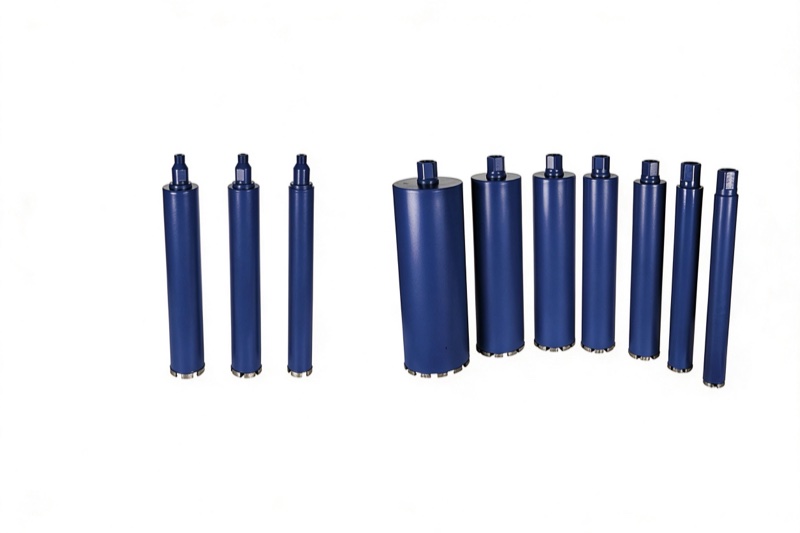
To drill a 45-degree hole in a concrete wall or slab safely, do not free-hand it on a handheld drill. Set a core drill stand to the desired angle with an angle gauge, anchor the rig to the surface, and use a wet diamond core bit at low RPM (400-800). Start with a pilot hole or a starter bit at full depth to lock the crown, then feed the angled barrel steadily. Handheld angled drilling above 30 degrees risks bit walk, sudden break-through, and wrist injury; a rig with an angle-compatible spindle adapter is the professional solution.
A perpendicular core hole is self-stabilizing: the annular face sits flat against the wall and the segments cut evenly around the ring. At an angle, the crown bites on one edge first, which forces the bit sideways. The operator has to resist that sideways load, and the hole tends to follow the path of least resistance, drifting toward perpendicular as depth increases. Without a guide, the exit hole ends up 5-20 mm off target and the wall edge spalls.
Angled holes are common for drainage pipes through foundations, cable conduits following a roof pitch, railings on sloped concrete, and chemical anchor sleeves that must land at a specific bearing angle. Each job has a tolerance, typically 1-2 degrees, that free-hand drilling cannot hold.
Most core drill stands have a column that tilts from 0 to 45 or 90 degrees, locked with a pivot bolt. Use a digital angle finder on the column to set the exact angle the engineer calls for. Anchor the stand to the wall or floor with wedge anchors into solid concrete, or use a vacuum base on smooth finished surfaces. The rig must not move during the cut: even 1 mm of slide at the start throws the whole hole off.
| Angle | Setup | Typical use | RPM |
|---|---|---|---|
| 0-15 deg | Handheld with guide | Minor offset conduits | 800-1400 |
| 15-30 deg | Tilted stand, anchored | Drainage sleeves, railings | 600-1000 |
| 30-45 deg | Rig on angle column | Pipe through foundation | 400-800 |
| 45+ deg | Custom frame or track | Roof pitch, structural | 300-600 |
At an angle, one side of the crown does most of the work until the barrel fully enters the concrete. That side wears faster. Use a bit with uniform segment height and a slightly harder bond so the leading side does not thin out halfway. For holes through rebar, a segmented reinforced-concrete crown survives the uneven load better than a continuous rim, which can crack when it catches on an angled rebar end.
Feed pressure is the safety knob. If the drill bogges, you are pressing too hard; the bit will climb out of alignment. If the crown chatters, back off and re-seat. The feed handle should turn with moderate effort, and slurry should emerge evenly along both sides of the annular cut.
The most dangerous moment on an angled hole is breakthrough. The bit suddenly loses resistance, the rig twists, and the operator can be pulled off balance. Reduce feed to a feather as the crown nears the far side, and never lock your body weight onto the feed handle. On wall work, have a second person ready to catch the core plug and support the drill as it exits.
For holes that must exit cleanly on the far face, a vacuum shroud on the entry side controls slurry, but on the exit side use a plywood backer board taped over the target to prevent spalling. After drilling, withdraw the barrel while still running at low RPM to clear the annulus.
Only for very shallow, non-critical holes. Above 30 degrees, use a tilted rig. Free-handing angled concrete work is a common wrist and shoulder injury source.
Most professional stands tilt 0-45 degrees from vertical. For steeper angles, fabricate a custom frame or use a track-mounted rig.
Yes, especially on angled entry. A short perpendicular pilot hole locks the crown so it cannot walk sideways when you start the angled cut.
Yes, by roughly 20-40 percent, because the leading edge of the crown carries uneven load. Use a harder-bond segment and expect shorter life per hole.
Angled concrete holes are a rig job. Set the angle with a gauge, anchor the stand, start with a pilot, and feed low and slow. The result is a straight, clean penetration at the exact angle the pipe or railing needs.
Written and reviewed by JOY TECH — an SGS & BV audited, CE/RoHS certified diamond tools manufacturer founded in 2004, exporting to 50+ countries.
Our factory and QMS are audited by SGS and Bureau Veritas. Products meet CE/RoHS requirements and every piece is 100% inspected before packing.
Verified Certificates
