Average response time: under 24 hours
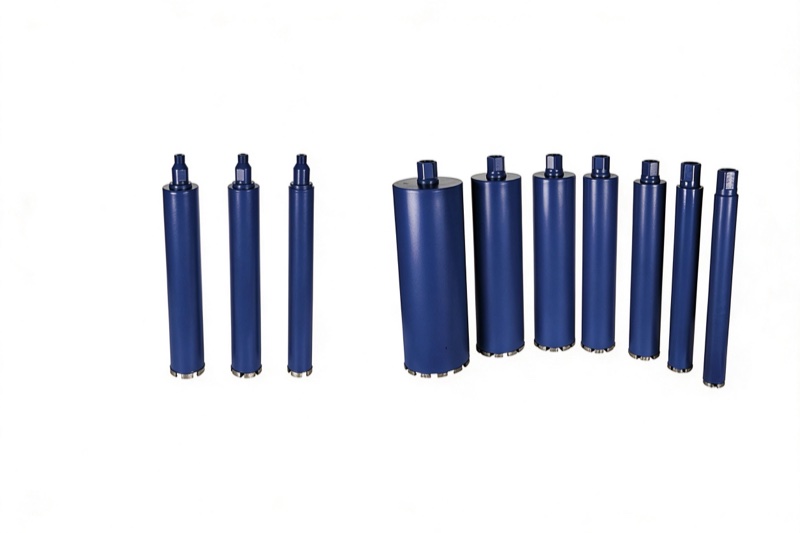
To drill a concrete wall for anchor bolts, use a hammer drill or rotary hammer with a carbide-tipped masonry bit sized to the anchor manufacturer's spec (usually 1/8" to 1/4" larger than the bolt diameter), mark the hole positions with a level, and drill straight in with light pressure while letting the hammer action do the work. Drill to the embedment depth marked on the bit, clear the dust, and test-fit the anchor before setting it. For large or deep holes, a diamond core bit on a drill stand gives cleaner, more precise holes.
A hammer drill (rotary hammer action) is the minimum for concrete. For frequent or heavy work, a rotary hammer (SDS) drills faster with less vibration. The bit must be carbide-tipped and sized to the anchor: check the anchor's data sheet for the exact hole diameter. A wedge anchor for a 3/8" bolt takes a 1/2" bit; the hole is always larger than the bolt so the anchor can expand. Bits come in exact sizes — do not use a worn bit that measures undersized, because the anchor will not seat.
For holes over about 12 mm or very hard aggregate, a diamond core drill bit on a drill stand cuts faster, stays straight, and leaves a clean hole without spalling the face. Core drilling is also the right choice when the wall is reinforced — it passes rebar better than a carbide bit.
Layout first: mark the fixture position, transfer the bolt centers with a level, and verify they are square to the reference edge. A laser level or a straightedge and tape measure works. Misaligned holes mean re-drilling a wall, so measure twice. Mark each center with a punch or a nail through the fixture before drilling — a punch keeps the bit from walking at the start.
Drill straight. On a wall, the natural tendency is to drift downward with gravity. Hold the drill level, or use a drill guide for critical holes. For a row of anchors, drill all holes to depth before setting any anchor, so you can adjust if one hole drifts.
Drill in with light, steady pressure — the hammer action cuts; pushing hard just wears the carbide. Let the bit self-feed. Pull the bit out every few centimeters to clear dust; a plugged hole overheats the bit and stops cutting. Mark the embedment depth on the bit with tape before starting so you do not drill too deep. Depth matters for anchors: too shallow and the anchor cannot expand fully, too deep and the fixture sits proud.
Stop when the tape reaches the concrete. Vacuum the dust from the hole — anchors set properly only in a clean hole, and dust left behind reduces holding force. Test-fit the anchor; if it will not seat, check the hole for debris or an undersized bit.
Set the anchor per its type: wedge anchors get a washer and nut, driven or torqued to spec; sleeve anchors expand by tightening the nut; epoxy anchors use a chemical cartridge injected into the cleaned hole before the threaded rod. Torque matters — overtightening crushes the concrete around the hole and reduces holding strength. Use a torque wrench where the anchor spec calls for one.
For heavy loads, verify the concrete is sound before drilling — cracked or spalled areas will not hold an anchor. If the concrete is poor, epoxy anchors distribute load better than mechanical ones. And always confirm you are not drilling into electrical conduit or rebar: a stud finder and caution near switches and panels are essential. For the same drilling logic applied to horizontal surfaces, see how to drill concrete without a hammer drill.
For large or reinforced holes, a diamond segment core drill on a stand keeps the hole straight.
Match the anchor manufacturer's spec — typically the hole is 1/8" to 1/4" larger than the bolt diameter. A 3/8" wedge anchor takes a 1/2" hole; a 1/2" anchor takes a 5/8" hole.
Not effectively. Concrete needs hammer action. Use a hammer drill or rotary hammer with a carbide masonry bit; a regular drill will burn out bits and make slow progress.
To the anchor's embedment depth, which is listed on the anchor data sheet — typically 1-1/2" to 2-1/2" for common sizes. Mark the depth on the bit with tape before drilling.
The bit is either dull, the hole is plugged with dust, or the drill is not running hammer action. Clear the hole, let the bit cool, and use a sharp carbide bit.
Drilling anchor holes in a concrete wall is a matter of the right tool, the right hole size, and patience: a hammer drill or rotary hammer with a carbide bit sized to the anchor, straight alignment, correct depth, and a clean hole. Measure the layout twice, drill with light pressure, clear the dust, and set the anchor to its torque spec. Done right, the anchor holds to the full rated strength and the fixture stays put.
Written and reviewed by JOY TECH — an SGS & BV audited, CE/RoHS certified diamond tools manufacturer founded in 2004, exporting to 50+ countries.
Our factory and QMS are audited by SGS and Bureau Veritas. Products meet CE/RoHS requirements and every piece is 100% inspected before packing.
Verified Certificates
