Average response time: under 24 hours
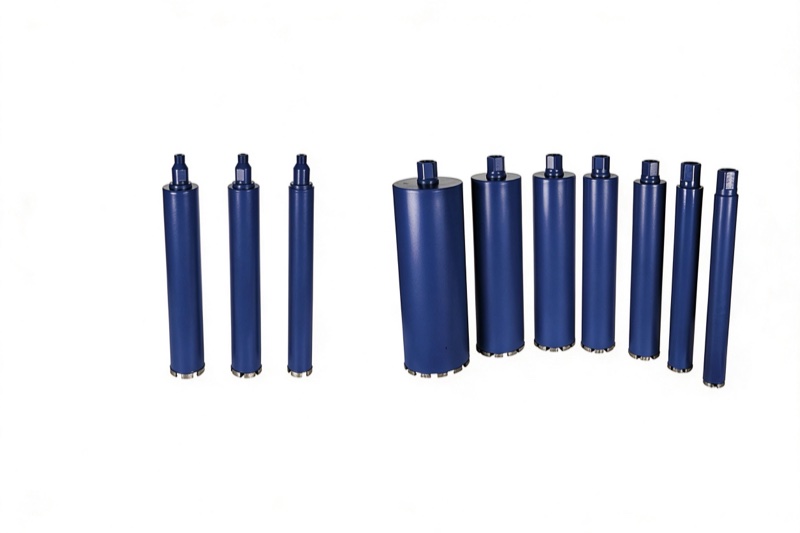
To drill 20 or more anchor holes in a concrete wall fast, switch from a hammer drill with carbide bits to a diamond core drill with a diamond core bit matched to the anchor size. Lay out all holes first with a template, use a vacuum-connected dust shroud, and batch-drill at steady RPM. A 12 mm diamond core bit on a 1500 W rotary drill cuts anchor holes in 30-60 seconds each, versus 2-3 minutes per hole with a hammer drill, and produces round, clean openings that do not require reaming. Keep one bit dedicated to concrete and a second on standby; when the first starts to slow, swap it rather than stopping to dress.
A single anchor hole is a one-off task. Twenty holes in a row is a production line. The operator moves along a wall or ceiling, drilling the same diameter to the same depth, and the bottleneck becomes bit changes, dust extraction, and repositioning. Hammer drills heat up after ten holes, carbide bits dull against rebar, and the operator tires from the vibration. Diamond core tooling cuts faster and steadier because it is not hitting the material; it is shaving it.
Plan the layout before touching the drill. Use a paper or MDF template with the hole centers marked, and a transfer punch to mark each point on the wall. A laser level projects a horizontal line so all holes sit on the same datum. Mark depth on the bit with tape, so every hole is identical without measuring each time.
Time is lost in setup, not in the cut itself. Stage the job so the operator does not walk back and forth.
| Setup | Time per 12 mm hole | Dust level | Edge quality |
|---|---|---|---|
| Hammer drill, carbide bit | 2-3 min | High | Chipped |
| Diamond core, handheld, dry | 60-90 sec | High | Clean |
| Diamond core, wet, handheld | 40-60 sec | Low (slurry) | Clean |
| Diamond core + vacuum shroud | 30-45 sec | Very low | Clean |
For anchor holes 8-16 mm, a thin-walled diamond core bit with a continuous rim cuts cleanest. For 25-65 mm holes (conduits, pipe sleeves), a segmented wet core bit is faster. On a batch job, use a dry diamond core bit with a vacuum shroud when water is not available; the dry bit life is shorter, but the speed of setup wins on interior finishes.
Do not overdress bits. A diamond bit that cuts slowly on batch work is usually either glazed (run it on a soft concrete block briefly to expose fresh diamonds) or worn past the segment height. Keep a log of holes per bit so you know when to retire it; running a worn bit costs more time in slow cuts than the bit itself.
Twenty holes in a shift is a repetitive strain job. Use a drill with a side handle and a torque clutch, stand on a stable platform for upper-wall holes, and take short breaks. Hammer drill vibration causes white-finger syndrome over a long day; diamond core drills run smoothly and the operator's hands stay fresh.
For overhead holes, a small rig or a vacuum base speeds things up and saves the shoulders. If you must handheld overhead, angle the vacuum shroud to catch dust and keep slurry out of the operator's face. A quick-change adapter between the drill and the bit cuts chuck time on multi-bit jobs.
As the operator moves along, spot-check every fifth hole for depth and diameter. A bit that is wandering off-axis produces holes that do not accept the anchor; caught early, you can re-align. At the end, blow all holes clean with a bulb syringe, then insert anchors. A batch of clean, round, consistent holes goes in faster than a batch of chipped, oversize, uneven holes that need chasing.
Yes, on batches. For one hole, the hammer drill is faster because there is no setup. For 20+ holes, the diamond core bit cuts 3-5 times faster per hole with no rework.
A 12 mm dry diamond core bit typically cuts 30-60 holes in light concrete. Keep a spare bit loaded and swap when penetration slows.
Water gives longest bit life, but a dry bit with a vacuum shroud is cleaner for finished interiors. Choose based on site rules; never drill dry in occupied spaces without dust extraction.
Use a laser level projected onto the wall, a paper template for spacing, and a transfer punch to mark each center. Drill vertically from the template line, not by eye.
Batch hole drilling on a concrete wall is a production task. Lay out the work, use diamond core bits with dust extraction, and keep bits and anchors staged. The job finishes faster, cleaner, and with less operator fatigue.
Written and reviewed by JOY TECH — an SGS & BV audited, CE/RoHS certified diamond tools manufacturer founded in 2004, exporting to 50+ countries.
Our factory and QMS are audited by SGS and Bureau Veritas. Products meet CE/RoHS requirements and every piece is 100% inspected before packing.
Verified Certificates
