Average response time: under 24 hours
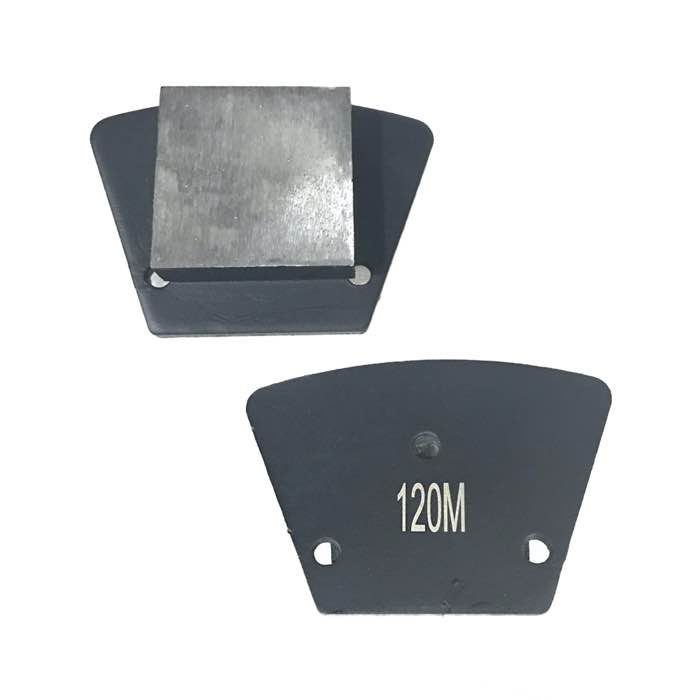
Yes — you must grind concrete before applying an epoxy coating. Grinding removes the weak laitance layer, opens the cement pores, and creates the CSP 3-5 surface profile that epoxy needs to mechanically bond. Use a planetary floor grinder with metal-bond trapezoid shoes such as the triple-round-segment trapezoid disc, starting at 30/40 grit and moving through 60/80 to 120/150. For edges and corners, use a diamond cup wheel on an angle grinder with a vacuum shroud. Finish by HEPA-vacuuming and apply the primer within 24 hours. Skipping the grind and relying on acid etching is the #1 cause of epoxy delamination on commercial slabs.
Fresh concrete bleeds water to the surface as it cures. That water carries cement fines with it, forming a thin, dusty, weak layer called laitance. If you pour epoxy straight over laitance, the resin bonds to the weak layer, not to the structural concrete. Within months the film peels in sheets — usually starting at a joint, a door threshold, or under a heavy roller. Acid etching removes some laitance but leaves an inconsistent profile and trapped salts; on a commercial slab it is never enough. Mechanical grinding is the only method that delivers a reproducible CSP.
For areas over 50 m², use a walk-behind planetary grinder (300-800 mm working width) with a 220V or 110V motor. Single-disc grinders are cheaper but leave swirl marks and take twice as long. For tooling, trapezoid or redi-lock metal-bond shoes are the standard. Choose the grit and bond based on the slab condition:
| Slab condition | Start grit | Bond | Finish grit |
|---|---|---|---|
| New slab, laitance only | 60/80 | Medium | 120/150 |
| Existing slab, light dirt | 30/40 | Medium | 120/150 |
| Old epoxy / glue to strip | PCD | PCD | 60/80 then 120/150 |
| Very hard dense concrete | 16/20 | Soft | 120/150 |
Do not skip grits. Start at the most aggressive grit needed, then step through 60/80 → 120/150. Each step must remove the scratch pattern of the previous one — run your hand across the floor; if you can still feel 30/40 grooves, the 60/80 has not finished. HEPA-vac between every grit change. The triple-round-segment trapezoid disc is a workhorse for the 30/40 step on medium slabs; switch to a double-arrow segment for hard concrete and a coffin segment for very soft. For edges, a double-row cup wheel on an angle grinder matches the scratch depth of the floor grinder within 5 cm of the wall.
After grinding, run your gloved hand over the floor. It should feel like 80-grit sandpaper — tactile but not grooved. Use an ICRI CSP comparator chip to verify: CSP 3 for thin self-leveling epoxy, CSP 4-5 for broadcast systems or urethane cement. If you have a CSP gauge, record it in the job file — clients and specifiers increasingly ask for this on handover.
Even a perfectly ground floor fails if moisture moves up. Test RH at 40% of slab thickness (ASTM F2170); it must be below 75% before standard epoxy, or below 85% if you use a moisture-tolerant epoxy. After grinding, apply the primer within 24 hours — the freshly opened pores adsorb airborne dust and oils quickly. If you must wait, re-vac the floor before priming.
For a residential garage with a 0.2 mm epoxy, acid etching is acceptable. For any commercial, industrial, or self-leveling epoxy, you must diamond-grind. The cost of grinding is recovered the first time the client does not have to strip and recoat.
Remove 0.1-0.3 mm — enough to take off laitance and expose fresh aggregate, not deep enough to alter flatness. You should see a uniform, scratch-pattern surface with no smooth shiny patches left.
Yes. Walk-behind grinders leave 5-10 cm unground along walls, columns and expansion joints. Use a cup wheel on an angle grinder with a vacuum shroud to match the floor scratch pattern. Un-ground edges are where epoxy delamination starts.
Within 24 hours, ideally within 4-8. If more than a day passes, re-vac and wipe with a damp rag; if more than 3 days, re-grind lightly to reopen the pores.
Grinding before epoxy is not optional — it is the adhesion mechanism. Match the trapezoid tooling and bond to your slab, run the full grit sequence, hit CSP 3-5, and prime within 24 hours. Done right, the coating outlasts every other choice on the job; done wrong, you are back to strip and re-grind in twelve months.
Written and reviewed by JOY TECH — an SGS & BV audited, CE/RoHS certified diamond tools manufacturer founded in 2004, exporting to 50+ countries.
Our factory and QMS are audited by SGS and Bureau Veritas. Products meet CE/RoHS requirements and every piece is 100% inspected before packing.
Verified Certificates
