Average response time: under 24 hours
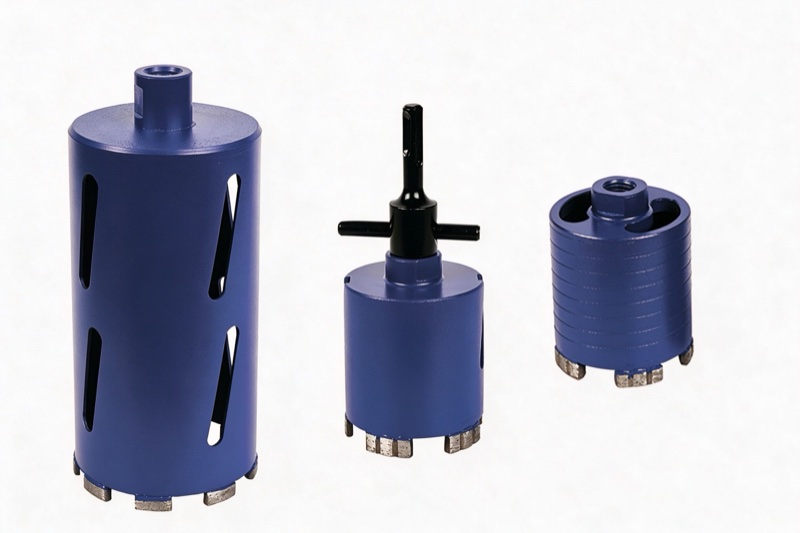
On a no-water job, keep the diamond core bit cool by drilling in short 20–30 second bursts, pulling the bit out between bursts so ambient air cools the segments, and clearing dust with a blower or vacuum. Use a dry-specific core bit — not a wet bit run dry — keep RPM at the lower end of the bit's range, and stop as soon as the barrel body feels too hot to hold. Overheating is the #1 reason dry bits glaze and die early.
In wet drilling, water carries away roughly 90% of the cut heat. Remove the water and all that heat goes into the bit. The bond softens, diamonds fall out early, and within minutes the barrel glazes — the bit spins but does not cut. Dry drilling is not "wet drilling without water"; it is a different process with its own bit design, feed rhythm, and cooling habits.
A wet core bit run dry will glaze in minutes. Dry bits are engineered with laser-welded segments, higher segment height, and an open bond that sheds heat. Our diamond dry core bit (JOY-DDC) is built for handheld rigs on interior walls, suspended slabs and rehab jobs where water is banned. Pair it with a dust collector adapter (JOY-DCA) to capture silica dust — workplace silica rules require it on enclosed sites.
| Situation | Why dry will fail |
|---|---|
| Hole deeper than 150 mm | Dust cannot escape, heat builds up |
| Bit hits rebar | Steel friction heat has no way to leave |
| Ambient temperature over 30 °C | Air cooling is too weak |
| Hole diameter over 100 mm | Contact area generates too much heat |
If any of these apply, run a water feed — even a small gravity-fed bottle through a core drill accessory beats dry grinding.
A: Briefly, yes — for one or two short holes. Expect the bond to glaze. Dress it back on a concrete block before the next wet run.
A: If the barrel is too hot to hold, you are already in trouble. Stop and cool. A bit that discolors (blue or brown tint) is burnt — retire it.
A: Yes, aimed into the hole between bursts. Never spray water directly on a hot barrel — thermal shock can crack the segments.
A: A quality dry bit should drill 10–20 holes in standard 200 mm block. Faster wear means wrong bond, too-fast RPM, or skipped cooldown cycles.
Dry drilling works — but only with the right bit, the right rhythm, and the discipline to stop and cool. Match the bit to the job, use bursts, blow out dust, and call us when you need a dry bit tuned to your material. Talk to JOY TECH for dry core bits shipped from Xiamen worldwide.
Written and reviewed by JOY TECH — an SGS & BV audited, CE/RoHS certified diamond tools manufacturer founded in 2004, exporting to 50+ countries.
Our factory and QMS are audited by SGS and Bureau Veritas. Products meet CE/RoHS requirements and every piece is 100% inspected before packing.
Verified Certificates
