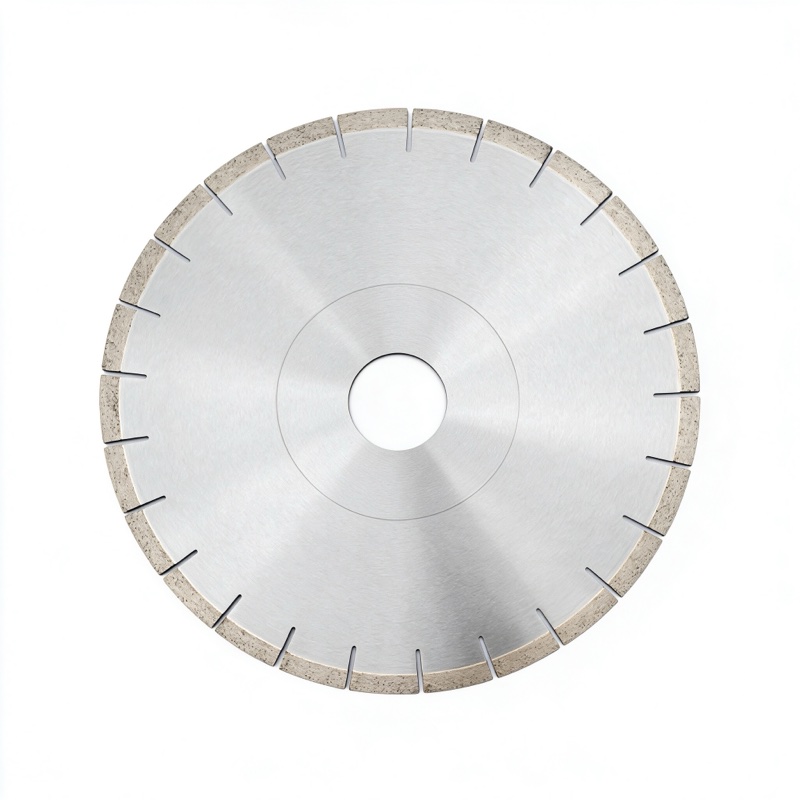
To cut straight in stone with an angle grinder, never freehand the cut. Mark the line, bolt or clamp a straightedge guide, score a shallow groove first, and then follow the groove in deeper passes. A precision diamond blade such as our granite precision cutting blade or Arix stone saw blade reduces wandering because its segments track cleanly.
Angle grinders have no base plate, so the operator's hand alone controls direction. The spinning blade can pull sideways if it binds, if the cut line is curved, or if the blade is dull. The fix is mechanical guidance, not a steadier hand.
Make the first pass a shallow 2-3 mm score, riding the guide. This creates a groove the blade naturally follows. On the second and third passes, deepen to full thickness. Cutting from the glazed/polished face side reduces chipping on the visible edge.
A thin kerf, well-centered blade tracks straighter than a thick, worn one. For marble and soft stone, use a continuous or turbo rim; for granite, a thin turbo or Arix-style blade minimizes wander and chipping. Keep the blade at 90 degrees to the surface throughout.
For long straight cuts in slab or countertop stock, a clamped aluminum rail pays off immediately. The grinder rides the rail, so your hand controls feed rather than direction. On curved or irregular stone, a template plus repeated trimming cuts beats trying to freehand an arc. Accuracy is built into the guide, not the operator.
As the blade wears, the offset between blade edge and guard changes slightly, so re-check your guide alignment after fitting a new blade. A blade that drifts usually means the guide moved, the bit is side-worn, or you are cutting too deep in one pass rather than stepping the depth.
A guide that shifts mid-cut ruins the job. Clamp the straightedge every 30-40 cm and test with a dry run before switching on water. On slippery stone, add a non-slip pad under the guide. Never hold the guide by hand while cutting.
Clamp a guide, score first, and step depth. Your hand is for feeding, not for steering.
Measure from the blade's cutting edge to the grinder guard edge, then clamp the straightedge at that offset. Test with a dry run: lower the grinder to the stone without water and check the line. Once aligned, clamp at both ends and mid-point. Mark the offset on a sticker taped to the grinder so you do not re-measure every cut.
If the blade drifts despite the guide, the cause is usually a side-worn segment, a blade too deep in one pass, or a loose guard. Re-score the line, step the depth, and re-tighten. A sharp centered blade follows its groove naturally.
Use a pencil line on the stone, not a pen that smears under water. Extend the line past the cut length so you can see it as the blade approaches the end. A square gives ninety-degree corners; a template gives arcs. Dry-fit the guide before turning on water.
A dull blade drifts. If your guided cut wanders despite a straight guide, dress the blade on abrasive concrete or replace it. Sharp diamond grit follows the groove; flat grit pushes sideways.
Aluminum straightedges slide smoothly and do not scratch stone. Clamp them every 30-40 cm. For very long cuts, a track saw guide gives the most repeatable result. Never hold the guide by hand; it will shift and ruin the cut.
A: A diamond jigsaw blade works for thin tile but is slow and less accurate than a guided grinder on stone slabs.
A: Usually a dull or side-worn blade, or cutting too deep in one pass. Re-score and step the depth.
A: Yes, on a wet saw or with a water feed; it reduces dust, heat, and chipping.
Straight stone cuts come from a clamped guide, a scored first pass, and a sharp thin-kerf diamond blade. Freehand cuts are never as true as guided ones. Contact JOY TECH for precision stone blades that track straight on your angle grinder or rail saw.
