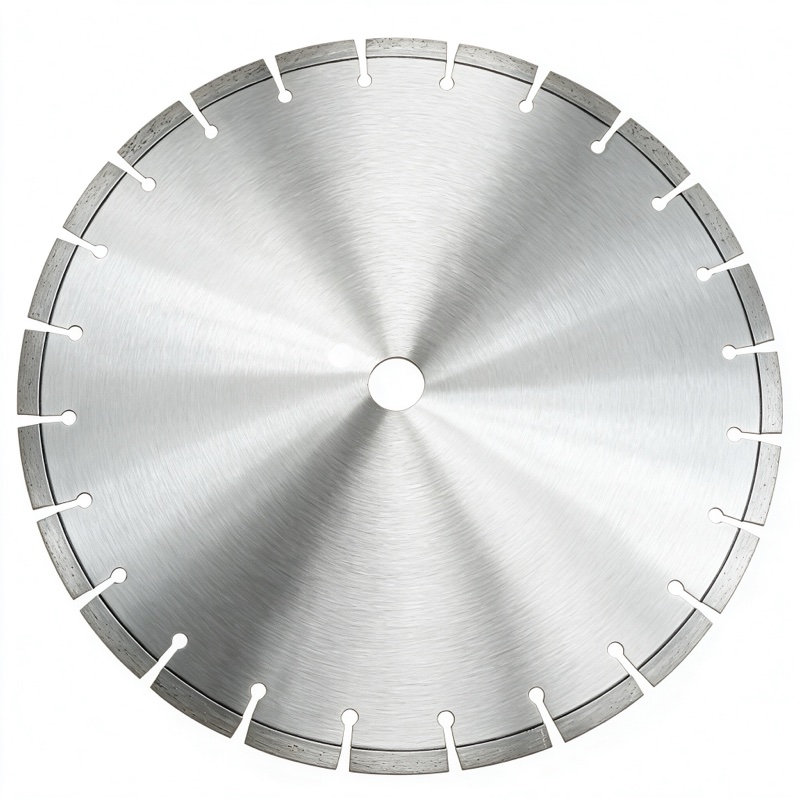
Laser-welded blades are stronger and safer for aggressive cutting of reinforced concrete, steel, and deep wet cuts, because each segment is welded to the steel core with a deep metallurgical bond. Sintered (hot-pressed) blades fuse the segment and rim during production and excel in thin, quiet tile and marble blades where precision matters. Neither is universally better; the welding method must match the cut.
In a laser-welded blade, diamond segments are pressed and sintered separately, then laser-brazed onto a steel core. The laser creates a deep, strong weld that resists pulling off under load. In a sintered marble blade, the diamond mix is pressed directly around the core rim and sintered in one mold, producing a thin, quiet, precisely shaped rim. Our laser-welded pavement blade shows the heavy-duty side of the technology.
| Feature | Laser welded | Sintered / hot pressed |
|---|---|---|
| Segment bond | Very strong, pull-off resistant | Good, thinner rim |
| Best materials | Reinforced concrete, asphalt, steel | Tile, marble, fine stone |
| Dry cutting | Excellent | Limited on hard materials |
| Rim thickness | Thicker, robust | Thin, quiet, precise |
| Heat resistance | High | Moderate |
If you cut reinforced concrete, asphalt, or run a walk-behind saw deep and hot, choose laser welded. The weld survives segment loading and rebar impacts that would strip a high-frequency brazed blade. Laser blades are also the standard for dry cutting on the job site because the weld does not weaken from intermittent cooling.
For porcelain, ceramic, marble, and engineered stone, a hot-pressed sintered blade cuts thinner, cooler, and quieter with less chipping. The slim kerf wastes less expensive stone and the continuous rim gives a polished edge. These blades are usually run wet on tile saws.
Laser-welded blades cost more upfront but last far longer on structural work, so cost per cut is usually lower. Sintered thin-rim blades are cheaper for tile shops but are not designed for rebar or deep demolition. Mixing the two processes on the wrong job is a false economy: a cheap sintered blade that loses segments on concrete becomes a safety hazard, not a saving.
When buying laser-welded blades, inspect the joint between segment and core on delivery. A clean, uniform weld bead with no gaps indicates proper penetration. Avoid blades with visible gaps, uneven welds, or segments that look merely tacked on; those are the ones that strip off mid-cut.
When sourcing overseas, specify both the welding process and the target material on your purchase order. A blade described only as a generic diamond blade could be either process. Request samples for both processes on your local aggregate before committing to a container order; the right bond matters more than the label.
Go laser welded for structural and reinforced work; stay sintered for thin, quiet, precision stone and tile. The right process is cheap insurance against segment loss.
Inspect a sample blade's segment-to-core joint. Laser welds show a continuous bright weld bead around the base of each segment; sintered blades have no visible weld because the rim is fused in the mold. Run the sample on your hardest material and watch whether segments remain seated under load. That test tells you more than any catalog.
For a contractor doing weekly reinforced-concrete cuts, the premium on laser-welded blades pays back in avoided segment loss and downtime. For a tile shop cutting porcelain, a cheap sintered blade is the right tool. Match process to daily work, not to a single price point.
If segments start disappearing mid-cut, the weld has failed. On a laser-welded blade this is rare and usually means the blade was abused by overheating or side grinding. On a poorly brazed blade it can happen on new stock. Inspect incoming blades; reject any with gaps at the segment base. A segment that detaches at speed is a serious projectile hazard.
Laser-welded blades cost more upfront but last far longer on structural work, lowering cost per cut. Sintered blades are cheaper for tile and marble shops. Do not buy a laser blade for light tile work; it is overkill and cuts slower than a thin sintered rim. Match the process to the daily material.
A: Usually yes per blade, but it lasts far longer on structural work, lowering cost per cut.
A: Briefly, but intermittent dry use overheats the thin rim. Sintered tile blades are designed for wet saws.
A: They sit between the two: strong enough for general concrete but not recommended for heavy rebar or deep demolition.
Choose laser welded for structural, reinforced, and deep cutting; choose sintered for thin, quiet, precision stone and tile work. Buying the wrong process for the job is a top cause of segment loss. Contact JOY TECH to specify laser-welded or sintered blades matched to your application.
