

How to Polish Concrete Stairs and Treads Smooth
How to Polish Concrete Stairs and Treads Smooth
Quick Answer
Polish stair treads with a small edge grinder or hand polisher, not a full-size floor machine. Keep the tool flat on the tread, work from riser to nosing, and stop one grit before the landing so the tread and landing can be blended together. Protect the nosing with tape or a temporary radius gauge, control water or dust at the tool, and inspect each step under raking light before moving to the next grit.
Why Stairs Need a Different Process
A stair tread is a narrow, supported slab with an exposed nosing. A large planetary grinder cannot reach the tread evenly, and its weight can chip the nosing when the head crosses the edge. A small hand-held or edge machine gives the operator control over pressure and travel direction.
The tread also dries faster than a floor because air moves on both sides of the step. Wet polishing can leave water under the nosing; dry polishing can overheat the resin. The practical answer is low water flow with a shroud, or a dust extractor with a dry pad, and short passes.
Tool Setup and Grit Sequence
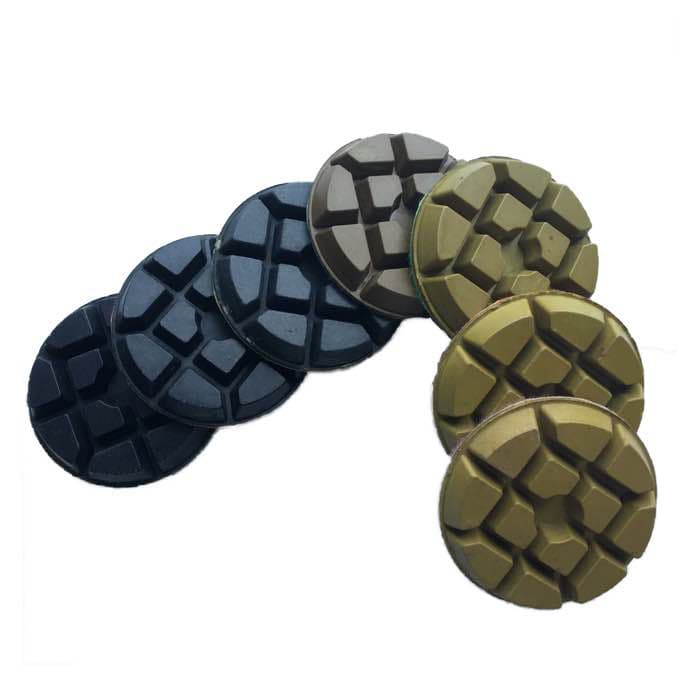
- Use a 3 in or 4 in resin pad on a flexible backer. A stiff backer will bridge the tread and miss low spots.
- Start with 30 or 50 grit only if the concrete is exposed and flat. If there is sealer or a thin coating, remove it with a 30 grit diamond or a coating removal tool first.
- Run 50, 100, 150, 200, 400 and, for a high sheen, 800 or 1,000 grit. Do not skip more than one step.
- Keep the pad wet but not flooded. A visible slurry should follow the pad, not run down the riser.
- Use a small wet vacuum at the nosing to catch water before it reaches the riser.
Working the Tread Without Rounding the Nosing
Start at the back of the tread and pull the tool toward the nosing. Keep the pad flat; tilting it on the last pass will cut a dish into the tread. When the pad reaches the nosing, lift the tool before it overhangs. Finish the nosing by hand with a flexible pad and light pressure.
If the nosing is already rounded, do not try to grind it square. Blend the radius into the tread with 100 and 200 grit, then polish the radius by hand. A sharp nosing on a public stair is a safety issue; a controlled radius is usually the better repair.
Blending Stairs With the Landing
Polish the landing first, then the treads. Use the same grit sequence and the same pad type. At the top step, run the edge tool over the joint with a 200 grit pad and feather the pressure so the scratch pattern crosses the joint. Check the joint with a straightedge and a raking light.
Frequently Asked Questions
Q: Can I use a floor grinder on stair treads?
A: Only with a small edge attachment and a very stable base. A standard planetary head is too large and too heavy for most residential treads.
Q: How do I stop water from running down the riser?
A: Use less water, keep the vacuum at the nosing, and work in short passes. Mask the riser with removable tape if the adjacent finish must stay dry.
Q: Why does the tread look blotchy after polishing?
A: Blotches usually come from uneven pad pressure, skipped grits or a sealer that was not fully removed. Re-cut with 100 grit, then repeat the sequence.
Conclusion
Stair polishing is a control problem: small tools, flat pads, tight water management and one grit at a time. For edge work, see our 3 in resin polishing pads; for tread and landing blending, use a consistent concrete and terrazzo resin pad.
Products used in this guide
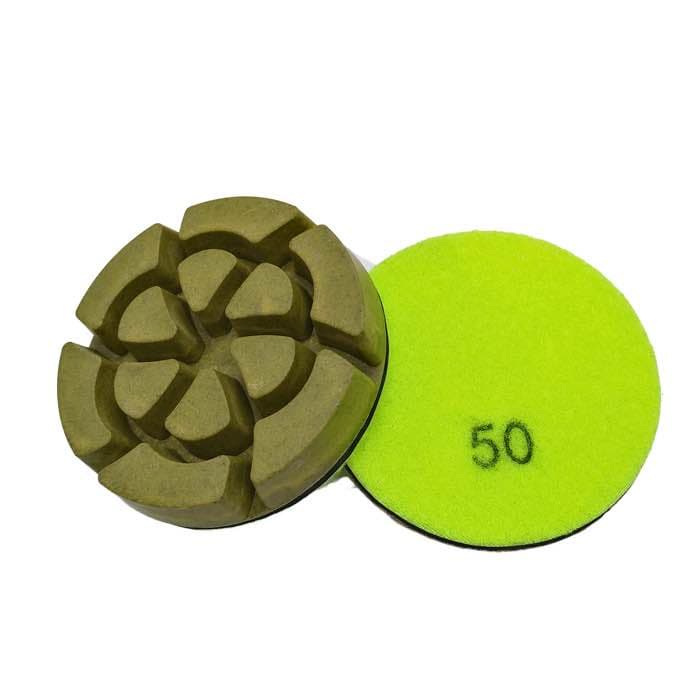
3'' Diamond Resin Floor Polishing Pads (JOY-RFP-05)
View specs →Diamond Resin Polishing Pads for Concrete Terrazzo Floor (JOY-RFP-01)
View specs →Need this tool for your job?
MOQ 1 · 7–30 days by order quantity · FOB & CIF · free sample on request
Author & Manufacturer
Written and reviewed by JOY TECH — an SGS & BV audited, CE/RoHS certified diamond tools manufacturer founded in 2004, exporting to 50+ countries.
Quality & Compliance
Our factory and QMS are audited by SGS and Bureau Veritas. Products meet CE/RoHS requirements and every piece is 100% inspected before packing.
Verified Certificates
- SGS Audited Supplier — Report No. QIP-ASI227442 & QIP-ASR247051 (Audit Jan 29, 2024)
- Bureau Veritas Verified — Report No. MIC-ASR257059 (Audit Feb 20, 2025)
- CE & RoHS Certificate of Conformity — No. CS240925001HRZ (Issue Sep 25, 2024)