Average response time: under 24 hours
A reasonable MOQ for stock diamond tools is 100-500 pcs per SKU, with a total order value of USD 3,000-10,000 FOB. For OEM private label (custom logo, packaging, or modified bond), MOQ jumps to 1,000-3,000 pcs per SKU because the factory has to set up a dedicated segment batch and printing die. Mixed-carton orders across SKUs are almost always accepted as long as the total quantity and total value meet the factory floor. Buyers pressing below these numbers usually pay a 10-25% unit surcharge and wait 10-15 extra days.
Diamond tools are made in segment batches. A cold-press mold holds 200-1,000 segments per cycle, and a single metal-powder mix batch is sized for 500-2,000 blades. Below that batch size, the factory still has to weigh powders, dress the mold, and run the sintering furnace, but the per-piece overhead spikes. Laser welding has a similar setup cost: loading the jig, dialing in the wire feed, and running test welds takes 20-40 minutes regardless of whether you weld 50 or 5,000 blades.
Understanding this helps you negotiate. Asking 'can you do 50 pcs?' is the wrong frame; asking 'what batch size makes your per-piece cost the same as 500 pcs?' usually surfaces a 150-200 pcs floor at near-stock pricing.
| Product | Stock MOQ | OEM MOQ | Typical surcharge below MOQ |
|---|---|---|---|
| 105-230mm saw blades | 100-300 pcs/SKU | 1,000-2,000 pcs/SKU | 15-25% |
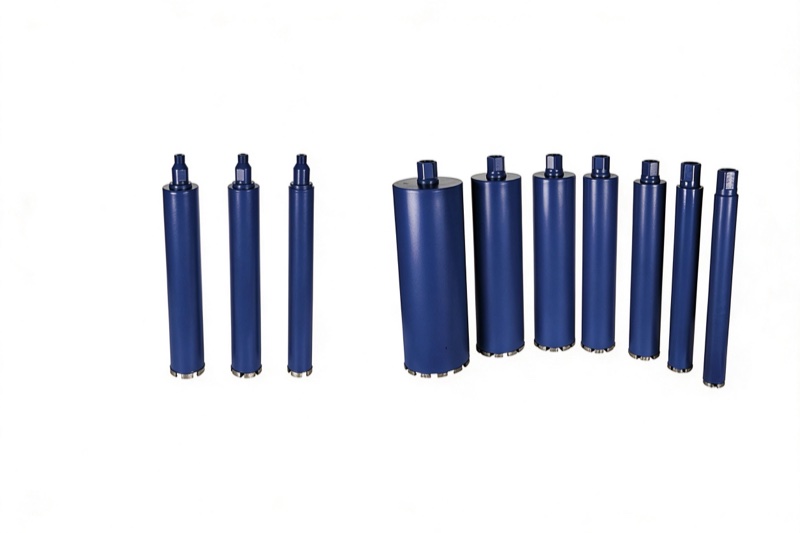
| 30-200mm core bits | 20-50 pcs/SKU | 300-500 pcs/SKU | 10-20% |
| Stone hole saw (20-65mm) | 50-100 pcs/SKU | 500 pcs/SKU | 15% |
| Bush hammer plates | 30-50 pcs/SKU | 300 pcs/SKU | 20% |
| Trapezoid grinding discs | 50-100 pcs/SKU | 500-1,000 pcs/SKU | 15-20% |
| PCD coating-removal tooling | 10-20 pcs/SKU | 100 pcs/SKU | 25-30% |
Notice that low-ticket, high-tool-cost items like PCD plates carry smaller absolute MOQs but higher percentage surcharges. High-volume commodity items like 105mm tiles blades carry large MOQs but the factory is flexible on total carton mix.
Two MOQs exist. The per-SKU minimum is what a single product code requires. The per-order minimum is the total shipment floor. A factory may quote 200 pcs/SKU with a USD 5,000 per-order minimum, which means you can order 200 pcs of SKU-A, 200 of SKU-B, and 100 of SKU-C only if the invoice crosses USD 5,000. Always ask for both numbers in writing; many email quotes omit the per-order floor and surprise you at PI stage.
Mixed pallet rules also matter. Cartons of 105mm blades are light (4-6 kg each), while cartons of 350mm laser-welded blades weigh 25-30 kg. Factories usually require per-carton uniformity, not mixed pieces inside one carton, because retail distributors re-sell by the carton.
Also consider the cash-flow angle. A lower MOQ spreads your working capital across more SKUs, which reduces inventory risk but raises unit cost. A rough rule: if you cannot forecast selling 50% of the order within 90 days, lower the MOQ and pay the surcharge rather than tying up cash. Buyers new to the category often over-order 3 SKUs and then sit on dead stock for a year; starting small on 10 SKUs is almost always the better first move. Your reorder data is what eventually earns you the 1,000-pc pricing.
Yes, but expect to pay retail or near-retail pricing. Most factories will sell 10-20 pcs per SKU at sample pricing (USD 15-40 per 105mm blade) and ship by DHL. Treat it as a market test, not a wholesale program.
Factories are profitable at USD 3,000-5,000 FOB per shipment. Below that, the paperwork, QC, and loading labor cost as much as the profit margin. Trading houses will take smaller orders but add 10-20% margin.
No. Sample orders are priced separately, usually 2-4x the bulk unit price, and ship by express. MOQ rules begin at the first production order, not the sample.
Yes. Most factories allow split shipment at no extra charge if both shipments go to the same destination. You pay the second ocean freight and a small documentation fee (USD 50-100). This helps distributors smooth inventory without holding 90 days of stock.
A reasonable MOQ is a negotiated number, not a fixed wall. Buyers who understand batch economics and forecast demand clearly usually end up ordering 200-500 pcs per SKU at near-1,000-pc pricing, and avoid the 15-25% small-order surcharge entirely. Treat MOQ as a starting point, pair it with a reorder commitment, and your diamond saw blades and diamond core drill bits sourcing program will stabilize within 2-3 orders.
Written and reviewed by JOY TECH — an SGS & BV audited, CE/RoHS certified diamond tools manufacturer founded in 2004, exporting to 50+ countries.
Our factory and QMS are audited by SGS and Bureau Veritas. Products meet CE/RoHS requirements and every piece is 100% inspected before packing.
Verified Certificates
