

Resin Polishing Pad Sequence for Hard Terrazzo
Resin Polishing Pad Sequence for Hard Terrazzo
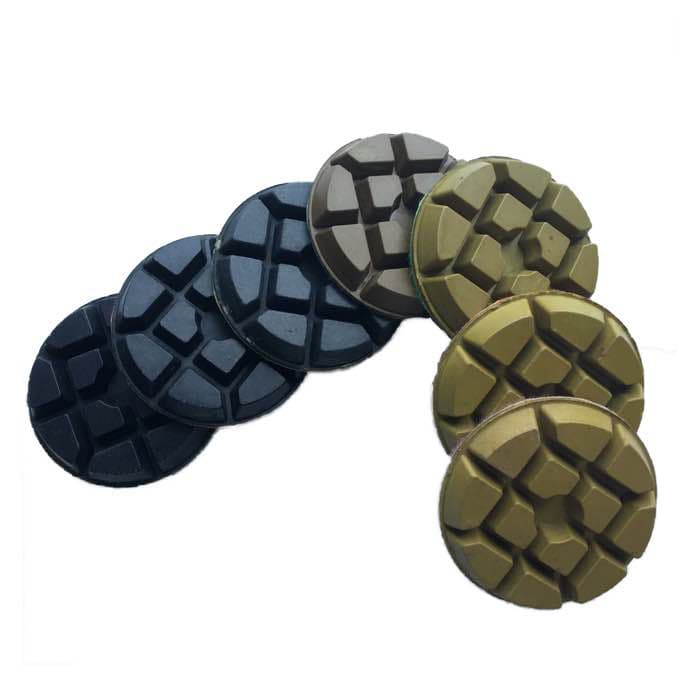
Quick Answer
For hard terrazzo, start with a 50 grit resin pad after the metal bond step, then 100, 150, 200 and 400. Use a transition pad if the metal-bond scratches are deep. Keep the pads wet, use light pressure and inspect under raking light before skipping a grit.
Why Hard Terrazzo Needs a Controlled Sequence
Terrazzo is a mix of aggregate and cement or resin matrix. Hard terrazzo contains dense marble, granite or quartz chips. The matrix can be softer than the chips, so a coarse pad cuts the matrix faster and leaves the chips standing proud. The next grit must flatten the chips without pulling them out.
Skipping from 50 to 200 grit leaves deep scratches that the 200 pad cannot remove. The surface looks cloudy and the gloss is uneven.
Grit Sequence
- 50 grit: remove metal-bond scratches and flatten the surface.
- 100 grit: remove 50 grit scratches; this is the key step for an even surface.
- 150 grit: refine the scratch pattern and start the sheen.
- 200 grit: prepare for the first gloss.
- 400 grit: build a uniform satin sheen; follow with 800 or 1,000 if a high gloss is required.
Transition Pads
If the metal bond leaves deep grooves, use a copper-bond transitional pad before the 50 grit resin. The transitional pad cuts like a fine metal bond but leaves a surface that the resin can refine. Do not use a transitional pad as a substitute for the 50 grit step.
Water and Pressure
Use enough water to keep the pad wet and the slurry moving. On hard terrazzo, too much water can hydroplane the pad and reduce cut; too little water overheats the resin. Start with a low flow and adjust until the slurry is visible but not flooding.
Use light pressure. Heavy pressure on a hard surface generates heat and can leave burn marks. Let the diamond cut.
Frequently Asked Questions
Q: Can I start at 100 grit on terrazzo?
A: Only if the surface is already flat and free of deep scratches. Starting too fine traps scratches under the polish.
Q: Why are the chips pulling out?
A: The bond is too soft or the pressure is too high. Use a finer grit and reduce pressure.
Q: How do I know the scratch pattern is removed?
A: Look under raking light at a low angle. If the previous grit scratches are still visible, repeat the current grit.
Conclusion
Hard terrazzo rewards patience at 100 grit. Use a consistent concrete and terrazzo resin pad, and add a copper-bond transition pad only when the metal-bond scratches are deep.
Products used in this guide
Diamond Resin Polishing Pads for Concrete Terrazzo Floor (JOY-RFP-01)
View specs →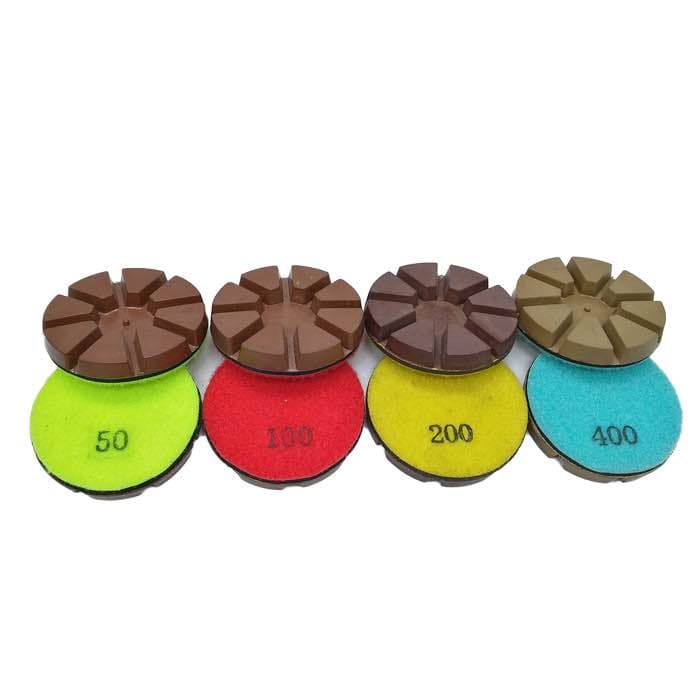
Copper Bond Diamond Transitional Polishing Pads (JOY-RFP-C2)
View specs →Need this tool for your job?
MOQ 1 · 7–30 days by order quantity · FOB & CIF · free sample on request
Author & Manufacturer
Written and reviewed by JOY TECH — an SGS & BV audited, CE/RoHS certified diamond tools manufacturer founded in 2004, exporting to 50+ countries.
Quality & Compliance
Our factory and QMS are audited by SGS and Bureau Veritas. Products meet CE/RoHS requirements and every piece is 100% inspected before packing.
Verified Certificates
- SGS Audited Supplier — Report No. QIP-ASI227442 & QIP-ASR247051 (Audit Jan 29, 2024)
- Bureau Veritas Verified — Report No. MIC-ASR257059 (Audit Feb 20, 2025)
- CE & RoHS Certificate of Conformity — No. CS240925001HRZ (Issue Sep 25, 2024)