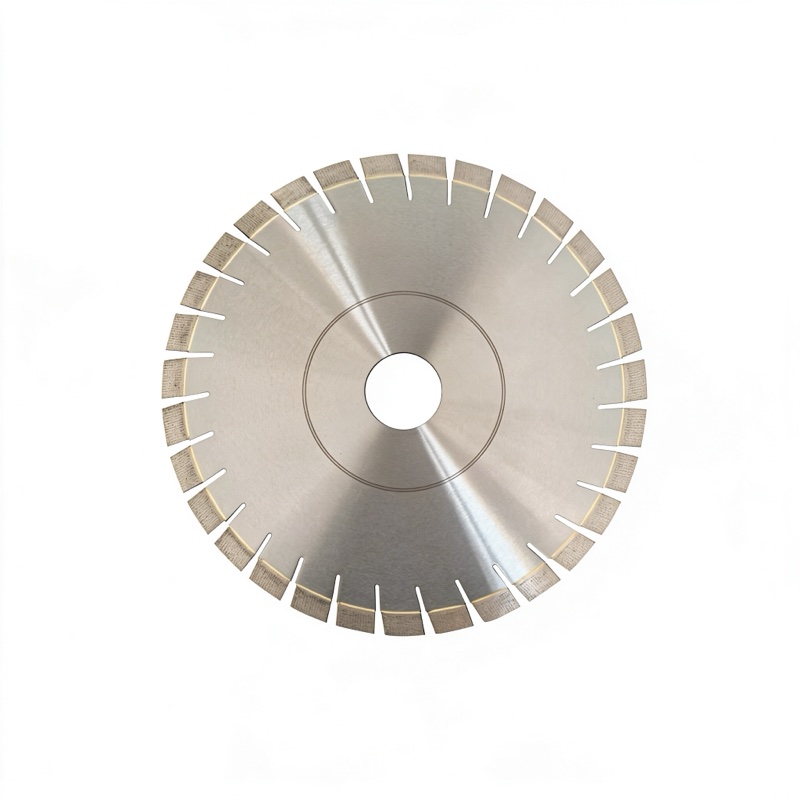
Choose the rim shape by material and finish: segmented rim blades are for fast, rough cutting of concrete, block and masonry where chip-free edges do not matter; continuous rim blades are for tile, porcelain and stone where you need a smooth, chip-free cut; and turbo rim blades sit in between - faster than continuous, smoother than segmented, good for general masonry and light concrete. Matching the rim to the job prevents chipping, overheating and premature blade failure.
Segmented blades have slots (gaps) between individual diamond segments around the rim. Those slots let air and waste clear quickly, which keeps the blade cool and allows aggressive cutting. Trade-off: the interrupted edge leaves a rougher cut. They are the standard choice for cured concrete, asphalt, cinder block and general demolition. Our Laser Welded Concrete and Asphalt Blade is a segmented-rim workhorse for floor saws and high-power cut-off saws.
A continuous rim is a solid, unbroken diamond edge. It cuts more slowly but produces the smoothest, chip-free finish, especially on brittle, glazed materials. Because there are no slots, it is usually used wet to flush swarf and cool the rim. It is the go-to for porcelain, ceramic tile, marble and glass. For porcelain and engineered stone, a purpose-built thin-kerf blade such as our hot-pressed ceramic tile blade minimizes chipping.
Turbo blades have a serrated or wavy continuous rim - no open slots, but a textured edge that removes material faster than a plain continuous rim. They offer a middle ground: faster than continuous, smoother than segmented. Turbo blades are popular for angle grinders cutting light concrete, brick, tile and stone where you want a decent finish without dedicating to wet saw work.
| Rim type | Cut speed | Finish | Best material |
|---|---|---|---|
| Segmented | Fast | Rough | Concrete, asphalt, block |
| Turbo | Medium-fast | Good | Brick, masonry, light concrete |
| Continuous | Slower | Smooth / chip-free | Tile, porcelain, marble |
Beyond rim shape, check the blade diameter, arbor and maximum RPM against your saw. A blade designed for a high-horsepower floor saw will not cut well on a small angle grinder, and vice versa. Wet materials like tile demand a blade rated for wet use with continuous rim; dry cutting of concrete relies on segmented cooling slots.
Rim shape is only part of blade choice. The segment bond and segment height also determine how the blade performs. A soft bond cuts hard stone freely but wears fast on soft concrete; a hard bond lasts on abrasive concrete but glazes on granite. When buying, tell your supplier the material, the saw horsepower and whether you cut wet or dry - they can match the bond rather than you guessing through trial and error.
Also inspect the core. A quality blade has flat, stress-relieved segments and clean cooling slots. Bent or warped cores wobble and cut poorly; never try to straighten a warped blade, as it can crack under rotation. Matching the rim, bond and core to your machine is what separates a clean, fast cut from a frustrating one.
A segmented blade on a small angle grinder cuts fast but roughly; a continuous rim on a large floor saw would overheat and wear oddly. Always match rim, bond and diameter to both the material and the machine. When in doubt, describe the job to your blade supplier and let them recommend the exact rim.
If you cut mixed materials on one job, keep dedicated blades rather than switching one blade between concrete and tile. Cross-use dulls and chips the rim unnecessarily.
When buying blades in bulk, order one extra segmented and one continuous blade so the right rim is always on hand for whatever the job throws at you.
Keep a small set of rim types on hand so you can switch the moment the material or finish demands it, rather than forcing the one blade you brought.
A: No. Segments chip and crack glazed tile. Use a continuous-rim or thin-kerf tile blade.
It works for light, occasional cuts, but for heavy cured concrete a segmented laser-welded blade cuts faster and lasts longer.
They can short dry cuts, but wet use is strongly recommended to prevent chipping and overheating.
Read the job: fast and rough calls for segmented, smooth and delicate calls for continuous, and turbo bridges the two. Using the wrong rim is the most common cause of chipped tile and burnt blades. The takeaway is that rim shape determines the whole cut experience. Match segmented, turbo or continuous to the material and finish you need, and cutting becomes fast, clean and predictable. Contact JOY TECH for a quote on segmented, turbo and continuous-rim diamond blades for your material.
