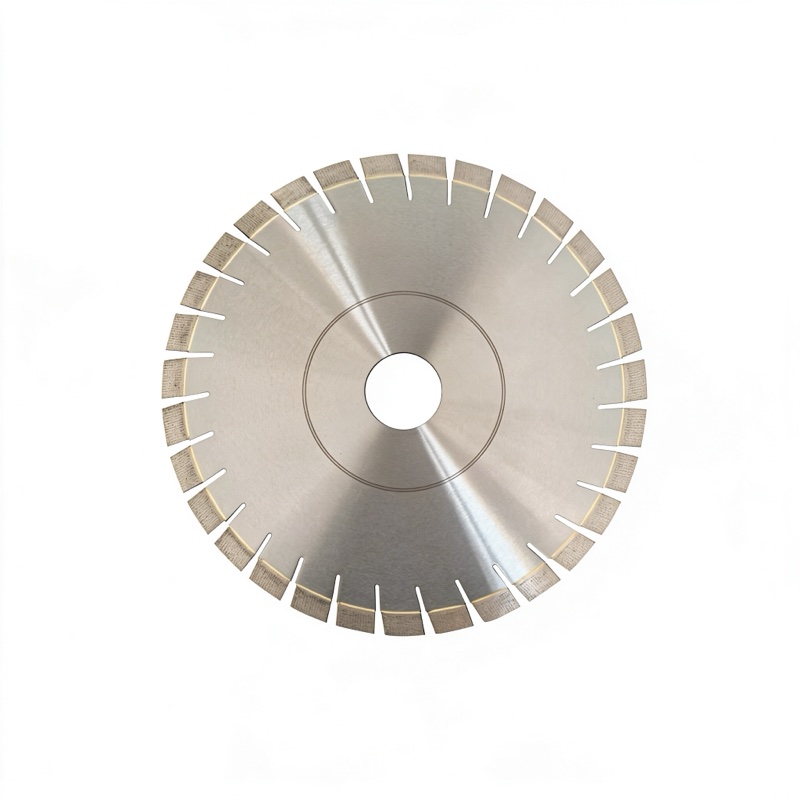
Choose a segmented rim for maximum cutting speed on concrete, brick, and block, where edge finish does not matter. Choose a turbo rim for a smoother cut in tile, stone, and masonry where chipping must be minimized. Continuous-rim blades give the finest finish but cut slowest and are reserved for porcelain and tile. The trade-off is simple: gaps cool and clear chips but leave serrations; a solid rim polishes the edge but traps heat.
A diamond saw blade rim comes in three architectures. Segmented rims have gaps (slots) between individual diamond segments. Turbo rims have a continuous core with undulating, wave-shaped segments. Continuous rims are a single solid band of diamond matrix. Our universal stone cutting blade demonstrates how a well-designed rim balances both goals.
| Rim type | Cut speed | Edge finish | Best for |
|---|---|---|---|
| Segmented | Fastest | Rough | Concrete, block, brick, asphalt |
| Turbo | Medium | Smooth | Stone, masonry, general-purpose |
| Continuous | Slowest | Finest | Porcelain, tile, marble |
Segment slots do three jobs: they let air and water cool the rim, they expel swarf quickly, and they reduce binding in soft materials. That is why segmented blades are the fastest in concrete and asphalt. The cost is tiny serrations along the cut wall from each segment entry-exit. Turbo rims blend cooling slots with a near-continuous cutting edge, giving a middle ground that most contractors prefer for everyday stone and masonry.
Hard, dense materials like granite and concrete reward a segmented rim with aggressive segments. Fine-finish materials like marble, porcelain, and glazed tile chip easily and need a continuous or turbo rim with a fine diamond grit. If a job demands both speed and finish, use a turbo for the bulk cut and a finishing blade for visible edges.
Segmented blades handle dry cutting best because the slots vent heat. Continuous and turbo blades run much longer wet; dry-running a continuous rim on porcelain quickly overheats and glazes the edge.
After a test cut, inspect the wall. A segmented rim leaves tiny serrations that are fine for hidden concrete joints but unacceptable on exposed stone facades. A turbo rim leaves a smoother wall with minimal chipping, while a continuous rim nearly polishes the edge. If the job mixes hidden and visible cuts, set up two saws or swap blades at the finish pass rather than trying to make one rim do both.
Taller segments run cooler because more of the rim is exposed to air or water between cuts. Shallow, thin turbo blades heat up faster on sustained cuts, which is why they are preferred for shorter tile and masonry runs. On long walk-behind cuts, the segment slots of a segmented blade actively vent heat, which is why they remain the standard for deep pavement work.
Many contractors run a two-blade system on the same saw: a segmented blade for the bulk demolition cut, then swap to a turbo for the finishing pass where the wall will be visible. This balances speed and finish without buying a compromise blade that is mediocre at both. Keep blades labeled by rim type so they are not mixed up on the truck.
If you remember one rule: rough structural work goes segmented, fine stone and tile go continuous or turbo. A two-blade kit for the saw beats one compromise blade on mixed jobs.
| Material | Recommended rim |
|---|---|
| Reinforced concrete | Segmented, laser welded |
| Brick and block | Segmented or turbo |
| Granite | Turbo or thin segmented |
| Marble | Continuous rim, wet |
| Porcelain | Continuous rim, wet |
When a job spans two materials, plan two blades rather than compromising. The slight cost of an extra blade is recovered in cleaner cuts and longer life on each.
After a cut, run a finger along the wall. A segmented rim leaves fine serrations that disappear under plaster but show on exposed concrete. A turbo rim leaves a nearly smooth wall. If the cut is decorative or will receive sealant, choose the smoother rim; if it is a demolition joint, speed matters more. When in doubt, cut a test offcut first to judge the finish on your exact material before committing to the full run.
A: Yes, but it will be slower than a segmented demolition blade and may glaze if used heavily on reinforced concrete.
A: A continuous-rim tile or porcelain blade on a wet saw gives chip-free results; turbo is acceptable for wall tile.
A: The serrations are normal on rough work. For a clean visible edge, switch to a turbo or continuous rim.
Pick the rim by the job: segmented for speed on structural concrete, turbo for everyday stone and masonry, continuous for tile and fine stone. When in doubt, carry two blades and switch at the finish pass. Contact JOY TECH for a full range of segmented, turbo, and continuous-rim blades for your market.
