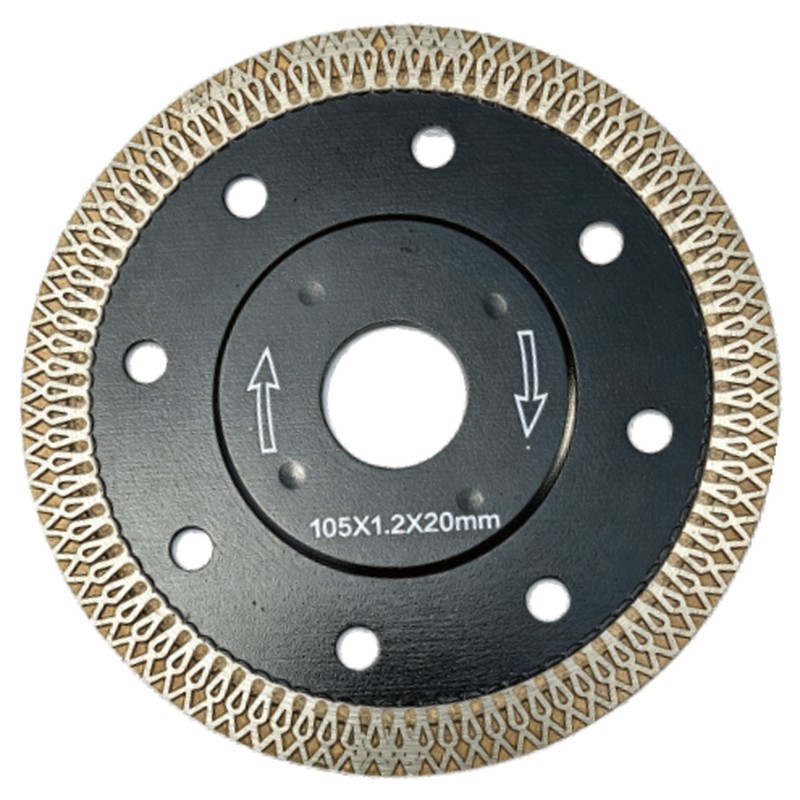
A turbo rim blade cuts tile cleaner than a segmented blade because its ribbed, near-continuous rim keeps the kerf narrow and supports the edge on both sides, reducing chipping. Segmented blades leave a 2-3 mm chip-out on glazed porcelain; turbo rims produce cuts that often need no further grinding. For porcelain, large-format tile, and glazed ceramic, always choose a turbo mesh or thin turbo blade — wet or dry depending on the saw.
A turbo rim has a continuous diamond-rim band with angled ribs cut into it. The ribs give chip clearance while the continuous backing prevents tile edges from spalling. The result is a cut that looks like a fine grind rather than a series of chipped segments.
| Rim Type | Chip Level | Speed | Best For |
|---|---|---|---|
| Continuous rim | Very low | Slow | Marble, glass tile, fine porcelain |
| Turbo / turbo mesh | Low | Medium-fast | Porcelain, ceramic, granite tile |
| Segmented | High | Fast | Concrete, stone, masonry |
Segment gaps are 5-10 mm wide. Each gap allows the tile edge to chip out as the blade exits the cut. On hard glazed porcelain, that chip-out is visible on the finished face and needs grinding. Turbo rims eliminate almost all gaps, so the edge stays intact.
Our turbo mesh porcelain disc and hot-pressed tile blade are engineered for 105-125 mm angle grinders and tile saws.
A: Turbo blades cut concrete too, but slower than segmented. They're best reserved for tile and stone where finish matters.
A: Turbo mesh is the sweet spot — clean cut and reasonable speed. Continuous rim is cleaner but slow; segmented is fast but chips.
A: Usually too hard a bond for the tile, or dry cutting on porcelain. Dress the blade on a scrap of abrasive block or switch to a softer bond.
A: Most tile saws use 105-125 mm blades with 20-22.23 mm arbor. Check your saw's max diameter.
For tile that needs a clean, chip-free edge, a turbo rim blade is the right tool. Browse our tile and porcelain cutting range for 4" to 14" turbo blades.
