Average response time: under 24 hours
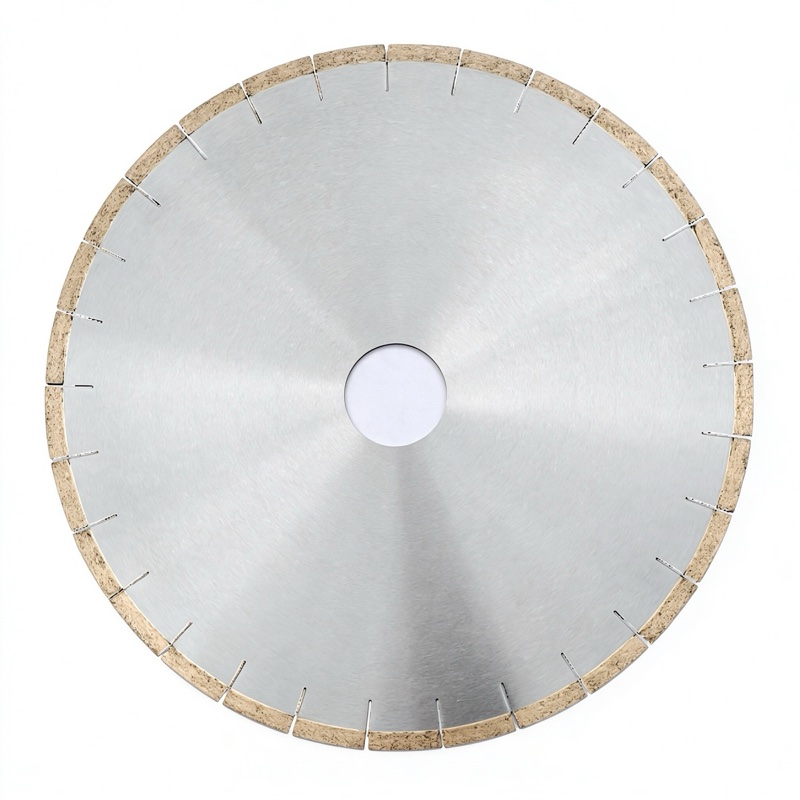
A concrete saw blade cuts a curve instead of a straight line when one side of the segment cuts faster than the other, pulling the saw toward that side. The usual causes are arbor or flange runout, a glazed diamond segment, a warped blade core, pushing the saw sideways, or a cut that is too deep for one pass. Fix it by cleaning the flanges, checking the arbor, re-breaking-in the blade on a soft abrasive, and reducing depth per pass to 30 to 50 mm on handheld saws. Most wandering is not the saw but a blade that has lost its side balance.
A diamond blade cuts straight only when both sides of the kerf are removed at the same rate. If the bond wears faster on one side, the diamonds on that side project farther and cut more aggressively, so the saw is pulled toward that side. The result is a gentle curve that looks like the operator is steering, even though the hands are holding the saw dead still. This is the most common reason a finished slab cut looks bowed rather than straight.
Runout is the second major cause. If the arbor is bent, the flanges are not flat, or a grain of concrete is trapped between the flange and the core, the blade wobbles side to side as it spins. That wobble is converted directly into a wavy or curved cut on the slab. On walk-behind saws, a loose front wheel or a worn drive belt can make the machine itself steer, which operators often misdiagnose as a blade problem.
Before swapping the blade, run through this checklist and match the curve shape to the cause:
Mount the blade and spin it by hand with the power off. Look at the side of the segment: a glazed blade looks shiny and smooth, while a sharp blade shows exposed diamond grit. Check the core for side cracks, broken segments, or a dished shape. A blade that has overheated often shows a blue or straw-colored tint around the arbor hole. If you see a crack, retire the blade immediately; a core can break apart at 3,000 rpm or more.
Remove the blade and clean the arbor, washers, and flange faces. Even a tiny chip of concrete between the flange and the core offsets the blade by fractions of a millimeter, which is enough to start a curve. Lay a straightedge across the flanges: they must be flat and parallel. On a high-horsepower walk-behind saw, a thick-core laser-welded blade resists side load far better than a thin economy core, which is why heavy saws wander less when fitted with the correct spec.
A glazed blade can often be restored by running it against a soft abrasive for 30 to 60 seconds. Cut through a cinder block, a soft concrete paver, or a piece of brick, leaning the saw slightly left and right so both sides of the segment wear evenly. The soft abrasive wears the bond and exposes fresh diamonds. Do this dry or with light water; friction is what restores the edge, not cooling. If the segment is still shiny after a minute, the bond is too hard for your aggregate and you need a softer-bond blade.
The deeper the cut, the more the kerf squeezes the segment sideways, and the easier it is for the blade to drift. Set handheld saws to 30 to 50 mm per pass and walk-behind saws to about 100 mm per pass, then finish the cut in several passes. This matters most on reinforced slabs: a rebar bar catches one side of the segment and pulls the saw off line. When you hit rebar, slow down and take shorter passes rather than forcing through at full depth.
Operators often cause the curve they are trying to fix by leaning the saw to one side as they walk. Keep the saw vertical on both axes and let the blade do the cutting. If you need to correct the line, move the whole saw in a gentle arc; do not twist the body, because that widens the kerf on one side and makes the wander worse. On a walk-behind unit, clear the track of debris and stones before each pass.
Choosing the right blade from the start removes most wandering problems. Match the bond to your aggregate: soft concrete wears a hard-bond blade quickly, so run a hard-bond blade; hard silica-rich aggregate wears a soft-bond blade too fast, so run a soft-bond blade. The diamond saw blade catalog lists blades by application, and the laser-welded JOY CA-LW blade is a safe general-purpose choice for slabs, curbs, and flatwork. If you have checked all of the above and the saw still curves, measure arbor runout with a dial indicator; anything over 0.05 mm at the flange face means the saw itself needs service, not a new blade.
Written and reviewed by JOY TECH — an SGS & BV audited, CE/RoHS certified diamond tools manufacturer founded in 2004, exporting to 50+ countries.
Our factory and QMS are audited by SGS and Bureau Veritas. Products meet CE/RoHS requirements and every piece is 100% inspected before packing.
Verified Certificates
