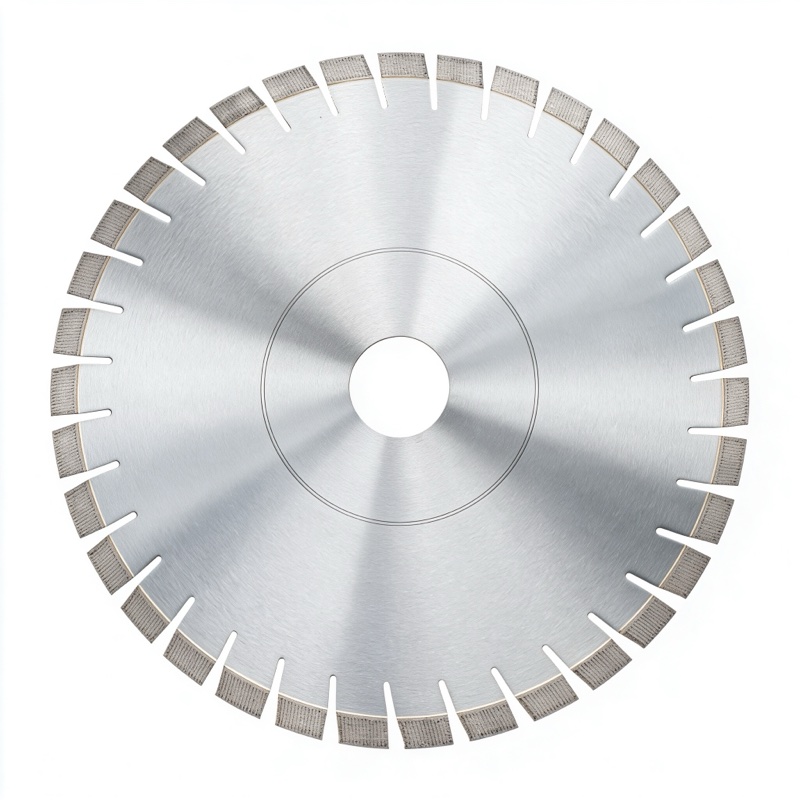
A wobbling diamond blade is almost always caused by one of four things: worn or wrong flanges, an arbor that does not fit, a bent or cracked core, or unevenly worn segments. A new blade that vibrates on installation points to flanges or the machine; a blade that developed wobble after use is likely worn, damaged, or glazed. Never run a blade that visibly side-oscillates.
First, mount the blade and spin it by hand with power off. Watch the rim against a fixed reference. If it wobbles off the saw, the blade core is bent. If it runs true by hand but vibrates under load, inspect flanges, arbor, and shaft bearings. A precision blade like our Arix stone saw blade relies on a flat seat; the universal stone blade should track without runout when installed correctly.
| Symptom | Likely cause | Fix |
|---|---|---|
| Wobble on new blade | Dirty/worn flanges, wrong arbor | Clean seats, fit reducer ring |
| Side oscillation | Bent core from binding | Replace the blade |
| Vibration under load | Glazed/uneven segments | Dress or replace blade |
| Grinder shakes | Bearing or shaft wear | Service the tool |
Flanges must be flat, clean, and the correct size on both sides. A buildup of sawdust or slurry under one flange tilts the blade. If you are using a reducer ring for arbor mismatch, confirm it is full-contact and not loose. A loose arbor nut lets the blade tilt under load.
Cutting only on one side of the blade, or cutting a curve with heavy side pressure, wears segments unevenly and creates a pulsing cut. Rotate the blade 180 degrees on the arbor if the design allows, and dress unevenly on an abrasive block to even the rim.
Some new blades wobble slightly because of minor core runout that a few minutes of gentle cutting beds in. If vibration persists after a couple of test cuts, do not keep forcing it. Remove the blade, inspect for core warping, and re-seat flanges. A balanced blade saves your wrists, your saw bearings, and your cut quality.
If two different blades both vibrate on the same tool, the problem is likely spindle bearings or a worn flange. Hand grinders take a beating; a worn spindle shaft cannot hold a blade true. Servicing the tool costs far less than replacing blades that are being ruined by bad runout.
If vibration appears after a cut, remove the blade, clean the flanges, and re-torque the nut. Slurry packing between blade and flange is a common hidden cause of runout on job-site grinders.
Check flanges and arbor first, then the core. A true, sharp blade cuts quietly and straight.
If wobble appears on a new blade: check flanges and arbor. If it appears on a partly worn blade: inspect for bent core and uneven segments. If it follows you across machines: the tool's spindle bearings are worn. Replacing the blade will not fix a worn spindle.
If segments wear unevenly from one-sided cuts, dress the rim on an abrasive block while running the grinder flat. Rotate the blade 180 degrees on the arbor where the design allows, so wear balances out over the blade's life.
If wobble persists after cleaning flanges and checking the arbor, the core is likely bent from a past bind. Do not true it; replace it. A bent blade cannot be safely straightened and will only get worse. Retire blades that show core cracks, undercut segments, or persistent vibration.
Grooved or dirty flanges cause wobble even with a correct arbor. Clean them daily and replace grooved flanges. A flat, clean seat is what keeps the blade true.
If vibration persists after cleaning flanges and checking the arbor, retire the blade. A bent core cannot be trued. Wobble that follows the same tool across multiple blades means worn spindle bearings, not a bad blade.
A new blade may seat after a few minutes of gentle cutting. If vibration persists beyond that, remove and inspect the core. Do not run a suspect blade at full load.
A: No. A bent core cannot be safely straightened; replace it.
A: Yes. Wobble translates directly into wavy walls and uneven segment wear.
A: A smooth hum is normal; noticeable shake or side play means stop and inspect.
Wobble is a warning, not a nuisance. Check flanges and arbor first, then the blade core and segment condition. A true, sharp blade cuts quietly and straight. Contact JOY TECH for flat, balanced diamond blades manufactured to tight runout tolerances.
