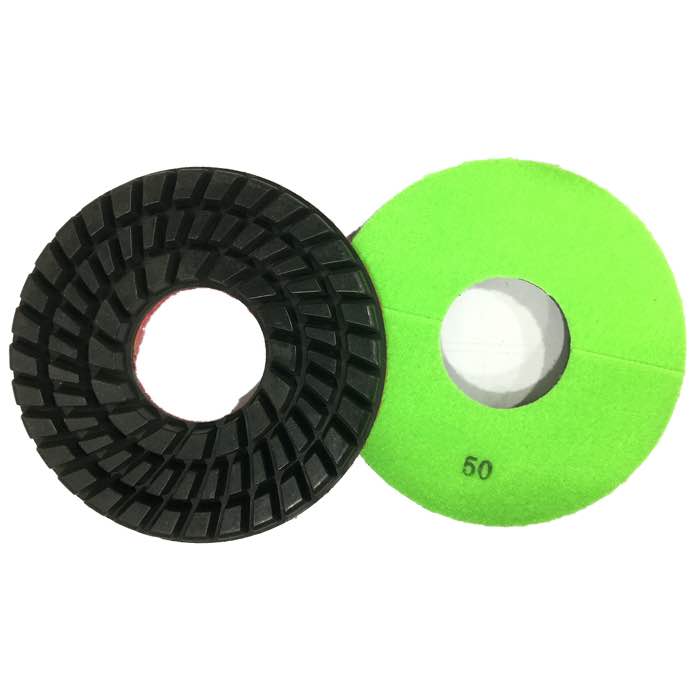
If your polished concrete still looks dull or matte after running the full grit sequence, the cause is almost always one of four things: the slab was not properly densified before resin polishing, you skipped or jumped grits leaving deep scratches, the resin polishing pads are too soft or too hard for your concrete, or the surface was not adequately ground flat and open in the metal stage. A truly reflective finish is built on a flat, dense, scratch-free substrate - you cannot polish shine into a soft, porous, scratched slab.
Gloss on polished concrete comes from compressing the cement paste into an optically smooth layer, not from coating it. When that layer stays rough or porous, light scatters instead of reflecting. The most common culprits:
Start with metal-bond diamond shoes to flatten and open the slab, then move in even grit steps (e.g. 30, 60, 120, 220). Apply the densifier once the floor holds a light slurry and has been cleaned, let it penetrate and dry fully, then continue with resin-bond transitional and polishing pads. For a reflective result, use quality resin pads such as our Diamond Resin Polishing Pads and finish through 800, 1500 and 3000 grit. Transitions between metal and resin are where installers lose shine, so a copper-bond transitional pad removes metal scratches cleanly.
| Symptom | Likely cause | Fix |
|---|---|---|
| Dull over whole floor | No densifier / soft paste | Re-open to 200 grit, densify, re-polish |
| Hazy, cloudy film | Densifier residue not removed | Buff with clean water and a 800-1500 pad |
| Patchy gloss | Uneven flatness / skipped pads | Re-grind low spots, repeat full sequence |
| Scratches visible in shine | Grit jump | Drop back one full step and progress evenly |
Too much pressure on resin pads loads them and causes glazing; too little pressure leaves swirls. Run the machine at the manufacturer's recommended speed, make deliberate overlapping passes, and keep the head flat on the floor. For the final burnish, a high-speed burnisher with the right pad lifts gloss far more than the planetary grinder alone. If pads are loading up with paste, switch to a sharper or harder bond designed for your concrete hardness.
When a floor will not gloss, work through the layers rather than guessing. First, wet a small patch and watch: if the patch suddenly looks dark and reflective, the surface is porous and under-densified, and shine returns only after a proper densification. Second, inspect under a bright work light at a low angle - if you see a repeating scratch pattern running one direction, you left scratches from an earlier grit and must drop back. Third, run a fresh pad on a test strip: if it cuts cleanly and the gloss jumps, your old pads were glazed or worn out. Fourth, check flatness with a 2-meter straightedge; waves cannot be polished away. Most no-shine calls are solved by one of these four checks, not by buying a better final pad.
Also remember that concrete mix design matters. A lean, dusty, low-strength slab (below roughly 3,000 psi) has weak paste that will never build a deep mirror, no matter how many grits you run. On such floors, set expectations to a satin honed finish and rely on the densifier to harden the surface rather than chasing a gloss the substrate cannot support.
Run this list in order whenever a polished floor disappoints: confirm the slab was densified while open; verify no grit step was skipped; check that the resin bond matches the concrete hardness; inspect flatness with a straightedge; and finally confirm the floor was burnished after 3000 grit. Nine times out of ten, the answer is one of these. Do not spend money on sealers or topical coatings to fake gloss - they wear off and obscure the natural reflection you are trying to build.
A: No. Higher grits only refine existing scratches; they cannot fix a soft, porous or badly scratched substrate. You must correct the foundation before polishing further.
A: Wet polishing can produce clarity, but excess water dilutes the densifier reaction. Dry polishing after densification is what builds reflection on most modern jobs.
A: Usually the slab kept dusting because it was never densified. The surface paste wears off under traffic, exposing dull aggregate and pores.
A: They enhance an already flat, dense floor. Burnishing pads cannot rescue a floor that was under-ground or under-densified.
A floor that refuses to shine is telling you the substrate is not ready. Check the densifier timing, confirm you did not skip grits, match the pad bond to your concrete, and re-establish flatness before blaming the polish. JOY TECH supplies resin polishing pads, transitional copper-bond pads and burnishing pads matched to concrete hardness. The takeaway is that shine is built from the substrate up, not added at the last step. Once you confirm flatness, density and a clean scratch sequence, the gloss you are looking for appears naturally. Rushing any of those stages is what produces the dull, cloudy floors contractors have to rework. Invest in the foundation and the final finish takes care of itself. Contact JOY TECH for a quote and our team will help you spec the right bond and grit sequence for your slab.
