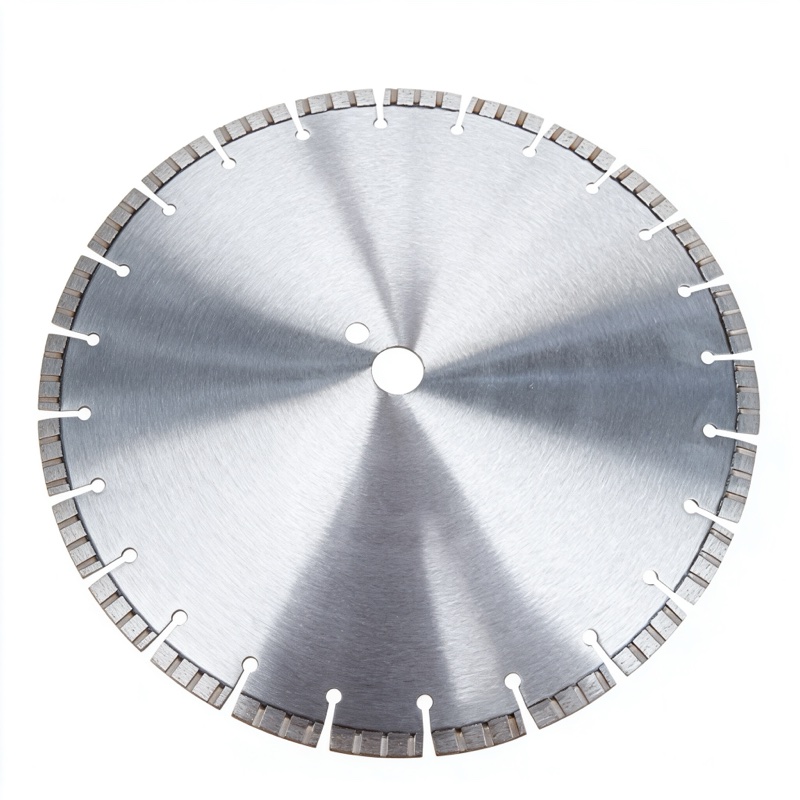
For cutting concrete curb and gutter, choose a 350-450 mm laser-welded segmented blade with a 10-12 mm segment height, a hard to medium-hard bond, and a 25.4 mm or 1" arbor that matches your walk-behind saw. Curb concrete is often hard and abrasive, so a hard-bond blade lasts longer; if you cut green (new) concrete, switch to a softer bond. Always wet-cut when possible to control silica dust and extend life.
Curb and gutter concrete is usually poured hard, sometimes with exposed aggregate and steel dowels. The cut is deep (100-200 mm), intermittent, and often done with a small walk-behind or hand-held saw. The blade must resist side load when you tilt the saw to bevel the curb face.
| Factor | Recommendation |
|---|---|
| Diameter | 350 mm (14") for 120 mm depth; 450 mm (18") for 170 mm |
| Segment height | 10-12 mm for long life on hard curb concrete |
| Bond | Hard-medium for cured concrete; soft for green concrete |
| Weld type | Laser welded (not silver brazed) for curb and rebar contact |
| Arbor | 25.4 mm (1") or 20 mm — match your saw flange |
| Wet/Dry | Wet preferred; dry only for shallow quick cuts |
Our laser-welded concrete & asphalt blade is designed for curb and floor saw work, while the high-horsepower blade handles reinforced curb and thick overlays.
A: 300 mm gives roughly 100 mm depth. Standard curb is 150-200 mm tall, so 350-450 mm is the practical range.
A: Yes. Green concrete is abrasive and gums up hard bonds. A soft-bond green concrete blade exposes diamond faster and cuts cleaner.
A: Use a curb-machine accessory or carefully tilt the saw after a vertical score. Never free-hand bevel with a large hand-held saw.
A: Hard bond on abrasive green concrete causes glazing. Dress the blade on an abrasive block or switch to a softer bond.
Pick a 350-450 mm laser-welded blade with 10-12 mm segments, match the bond to cured vs green concrete, and always wet-cut. For heavy curb and gutter work, our concrete cutting range covers hand-held to walk-behind saws.
