

How to Choose Polishing Pads for Stone Fabrication
How to Choose Polishing Pads for Stone Fabrication
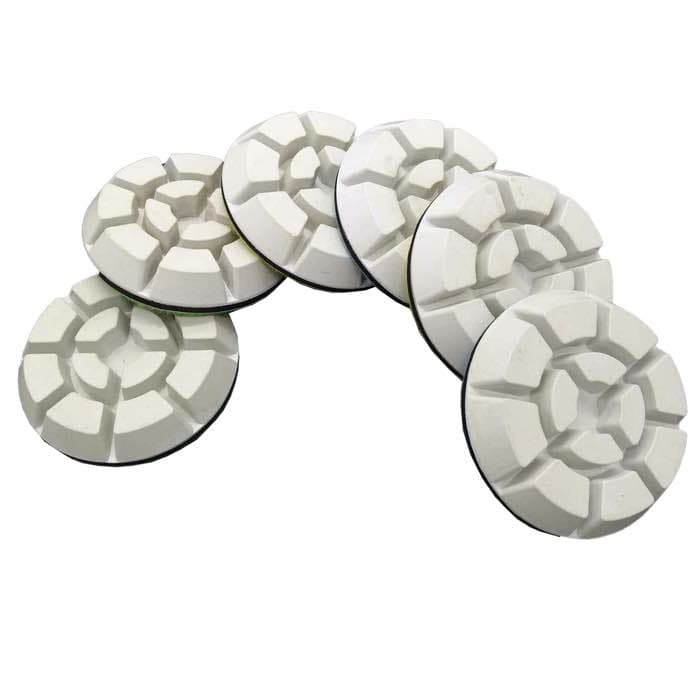
Quick Answer
For stone fabrication, use wet resin-bond diamond pads on granite and marble: start 50–100 for edge profiling, step to 200–400, then 800–1500–3000 for a mirror edge. Choose 4-inch pads for edges and 5-inch for tops, and always work wet to prevent heat fractures.
Key Features of Fabrication Pads
- Wet application: water cools the stone and flushes swarf, preventing burns.
- Resin bond: flexible resin pads follow edge profiles and radius work.
- Grit set: 50–3000 covers profiling to mirror finish.
- Backing: hook-and-loop or fixed; match to your angle grinder backing plate.
How to Choose by Stone and Step
| Stone | Profiling | Polish | Gloss |
|---|---|---|---|
| Granite | 50–100 | 200–800 | 1500–3000 |
| Marble | 50–100 (lighter touch) | 200–400 | 800–1500 |
| Quartz (engineered) | 50–100 | 200–800 | 1500–3000 |
How to Use It
- Profile the edge with a router or hand pad at 50–100 grit, wet.
- Step through white resin polishing pads to remove router marks.
- Finish edges with 1500–3000 on a small pad holder for a mirror edge.
- Keep the stone wet throughout; dry pads burn granite and dull marble.
Frequently Asked Questions
Q: Which grit gives a mirror edge on granite?
A: Granite mirrors at 1500–3000 with wet resin pads; 3000 produces the deepest reflection.
Q: Can I use concrete polishing pads on stone?
A: Some overlap, but stone pads are formulated for wet, dense application — use dedicated fabrication pads for best results.
Q: Do fabricators use 3-inch or 4-inch pads for edges?
A: 4-inch is the standard for most edges; 3-inch fits tighter radius work and sinks.
Conclusion
Match the pad line to the stone and always work wet. Profile with coarse grit, step through resin, and finish at 3000 for a mirror edge. Start with white resin polishing pads for consistent fabrication results.
Setting Up for Consistent Edges
Stone fabrication quality comes from a consistent grit sequence and a steady water feed, not from the most expensive pad set. Keep the same grit order on every job so your crew develops a feel for timing, and replace pads before they leave inconsistent scratches. Match the backing plate to your angle grinder — a loose or mismatched backing ruins edges faster than the pad wears. When working marble, lighten the pressure and slow down; when working quartz engineered stone, watch heat and increase water if the edge discolors. If pad life drops on a specific stone, ask the supplier for a bond tuned to that material.
Products used in this guide
Diamond White Resin Floor Polishing Pads (JOY-RFP-04)
View specs →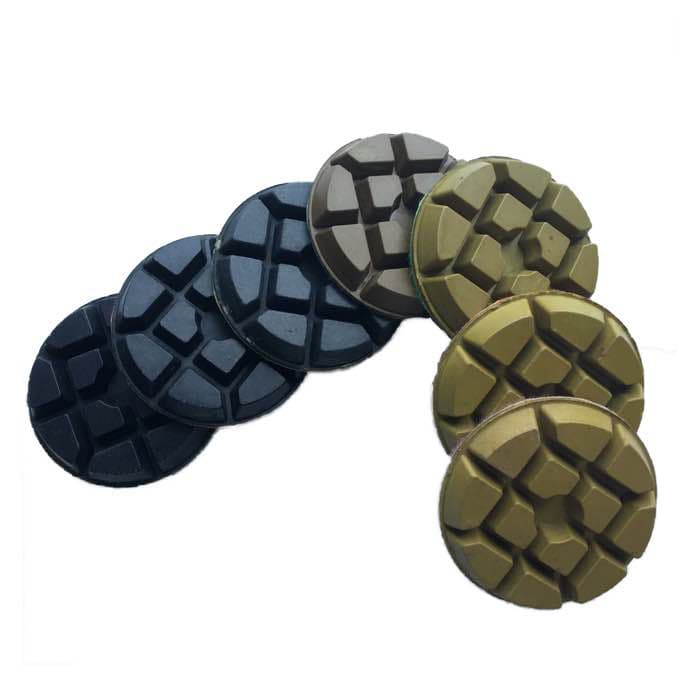
Diamond Resin Polishing Pads for Concrete Terrazzo Floor (JOY-RFP-01)
View specs →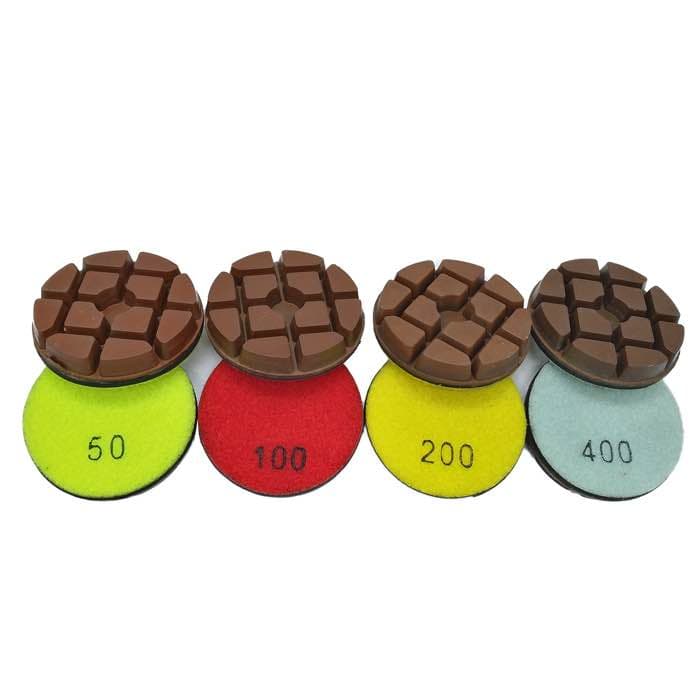
Typhoon Type Diamond Copper Bond Hybrid Resin Polishing Pads (JOY-RFP-C1)
View specs →Need this tool for your job?
MOQ 1 · 7–30 days by order quantity · FOB & CIF · free sample on request
Author & Manufacturer
Written and reviewed by JOY TECH — an SGS & BV audited, CE/RoHS certified diamond tools manufacturer founded in 2004, exporting to 50+ countries.
Quality & Compliance
Our factory and QMS are audited by SGS and Bureau Veritas. Products meet CE/RoHS requirements and every piece is 100% inspected before packing.
Verified Certificates
- SGS Audited Supplier — Report No. QIP-ASI227442 & QIP-ASR247051 (Audit Jan 29, 2024)
- Bureau Veritas Verified — Report No. MIC-ASR257059 (Audit Feb 20, 2025)
- CE & RoHS Certificate of Conformity — No. CS240925001HRZ (Issue Sep 25, 2024)