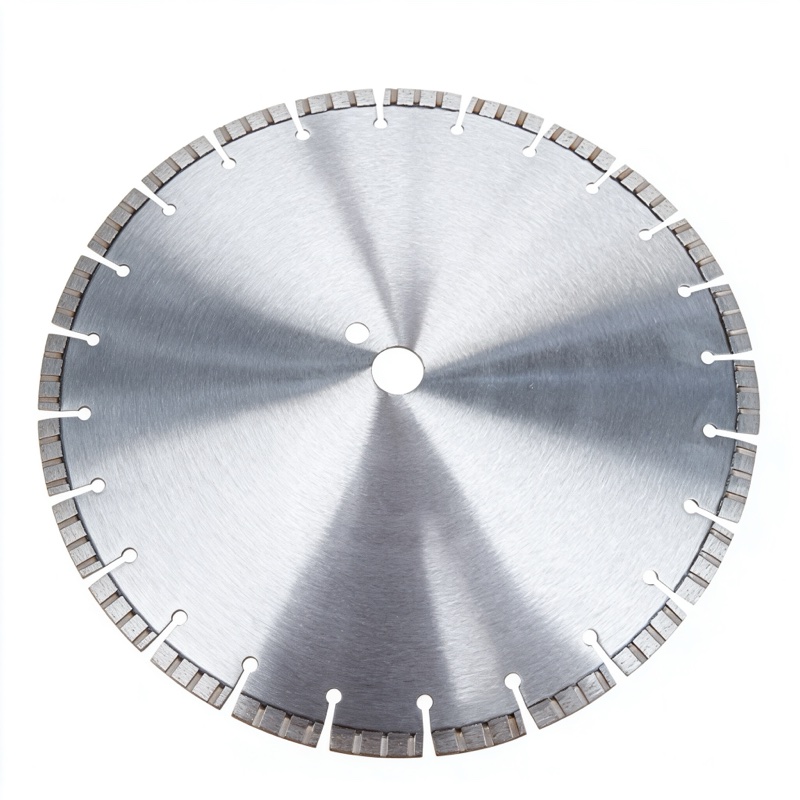
Yes, an angle grinder with a segmented diamond cutting disc can cut concrete, block and brick for small jobs - expansion joints, chasing channels, trimming slabs and short openings. Use a 4-1/2 or 5 inch segmented diamond blade rated for concrete, keep the guard on, cut in shallow passes rather than forcing deep cuts, and use dust extraction or wet suppression. The practical maximum depth on a 5 inch blade is about 1-1/8 inches; for deeper cuts you need a dedicated cut-off saw or walk-behind slab saw.
Not every disc cuts concrete well. Abrasive masonry discs wear fast and create huge dust. A segmented diamond blade is far more efficient and lasts hundreds of times longer. For angle grinders, a segmented or turbo diamond blade sized to your grinder (4-1/2 in / 115 mm or 5 in / 125 mm) is correct. Our Universal Stone Cutting Blade handles concrete, block and brick on small grinders, while the laser/high-frequency concrete blade suits heavier floor and road work.
Do not try to cut to full depth in one pass. Score a shallow groove along the line first, then deepen it in 3-5 mm passes. Let the blade do the cutting - pushing hard overheats and glazes it. Keep the blade at a consistent angle and move smoothly; sideways twisting jams the blade. For a straight line, use a straightedge guide or rail. Cut from the face side and support the waste piece so it does not bind the blade.
| Blade size | Useful cut depth | Best for |
|---|---|---|
| 4-1/2 in (115 mm) | ~25 mm | Block, brick, chasing |
| 5 in (125 mm) | ~30 mm | Small slab trimming |
| 9-14 in cut-off saw | up to 100+ mm | Deep joints, slab work |
The main danger is the blade pinching in the cut as the concrete shifts or the waste drops. Cut from above so the kerf stays open, prop the waste side, and never twist the blade sideways in the cut. If the blade binds, shut off the grinder and wiggle the kerf open with a wedge - do not twist the tool free.
Before cutting concrete with a grinder, know what is in the slab. If you hit hidden rebar, a standard concrete blade will dull and overheat instantly. Locate reinforcement with a rebar scanner where possible, and plan joints to avoid it. If you must cut through steel, switch to a metal-cutting or multi-purpose blade rather than burning through your concrete segments.
Depth matters too. A 5-inch grinder only reaches about 30 mm; for deeper control joints or openings, cut from both sides or rent a larger saw. Never pry a blade deeper by forcing it - the kerf will bind. Measure the needed depth first and choose the tool that reaches it in controlled passes, keeping the guard between you and the blade at all times.
Keep spare blades on site, because a worn blade cuts slower and hotter. Match the disc diameter to the grinder rating and never exceed maximum RPM. With the right segmented diamond disc, an angle grinder handles small concrete jobs quickly and cleanly without renting a larger saw.
Start shallow and let the blade reach depth gradually. Forcing a thick cut in one pass is the fastest way to stall the grinder and glaze the disc.
A: Standard concrete blades are not designed for rebar and will damage segments. Use a metal-cutting or multi-purpose blade for steel.
About 30 mm (1-1/8 in). Deeper requires multiple passes from both sides or a larger saw.
Wet cutting reduces silica dust, but use only on a GFCI-protected circuit and a grinder rated for wet use.
An angle grinder with a segmented diamond disc handles small concrete cuts well, provided you respect depth limits, control dust and cut in shallow passes. For large or deep work, step up to a cut-off saw. The takeaway is that an angle grinder handles small concrete cuts well within its depth limits. Use a segmented diamond disc, shallow passes and dust control, and step up to a larger saw when the cut gets deep. Contact JOY TECH for a quote on angle-grinder diamond blades for concrete and masonry.
