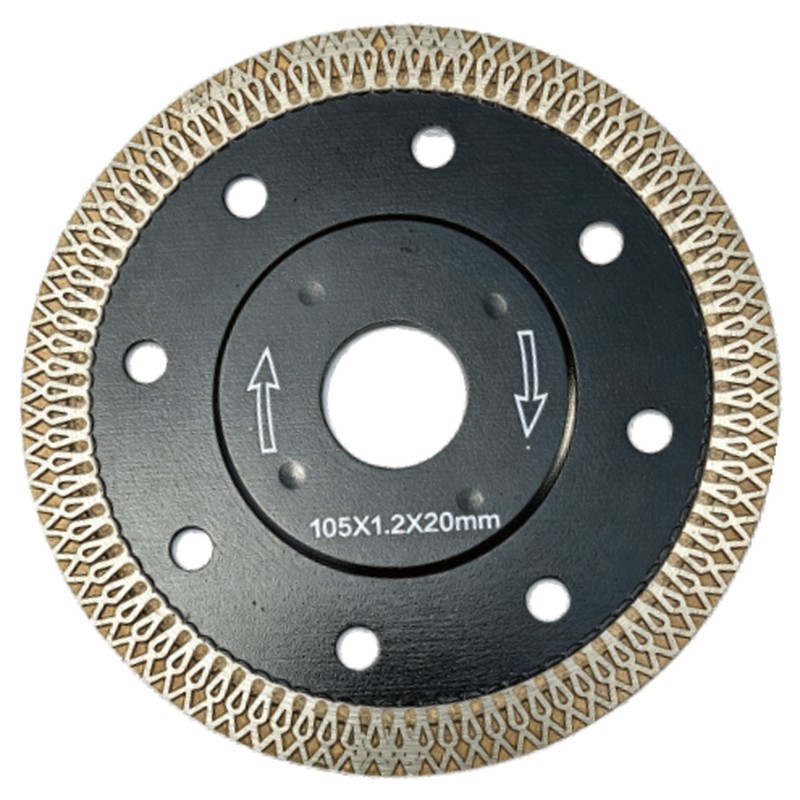
Yes, a mesh rim blade is the right choice for cutting thin porcelain slabs (6-12 mm). The mesh or "basket" rim is a lattice of diamond segments that reduces the contact area with the material, cutting cooler and with less vibration — which is exactly what prevents chipping on thin, brittle porcelain. Run it wet on a rail or bridge saw at the rated RPM, feed slowly, and support the slab on both sides of the cut.
Thin porcelain (6-10 mm) is extremely hard but brittle. A conventional turbo blade hammers the edge and causes chips that spread. A mesh rim blade has a perforated diamond lattice that cuts like a series of small teeth — lower impact per segment, cooler running, and a clean chip-free edge. It's also better for very large panels where vibration is amplified.
| Factor | Recommendation |
|---|---|
| Rim type | Mesh / basket rim |
| Wet/Dry | Wet only |
| Saw | Rail saw or bridge saw, rigid table |
| Feed rate | Slow, constant — no forcing |
| Blade diameter | 250-300 mm for most slab saws |
| Support | Support slab on both sides of cut |
Our turbo mesh porcelain disc is engineered for 250-300 mm slab saws cutting porcelain and sintered stone.
A>Yes, but a turbo rim may cut faster on thick material. Mesh wins on thin panels where chip control matters most.
A>Both work; mesh clears slurry better and runs cooler on long cuts. Continuous rim gives the very cleanest finish on short cuts.
A>Regular segmented or turbo blades impact too hard. Switch to mesh rim and slow the feed.
A>Not recommended — dry cutting micro-cracks the edge. Wet cutting is standard for porcelain slabs.
Mesh rim blades deliver chip-free cuts on thin porcelain slabs. Browse our porcelain and sintered stone range for rail saw discs.
