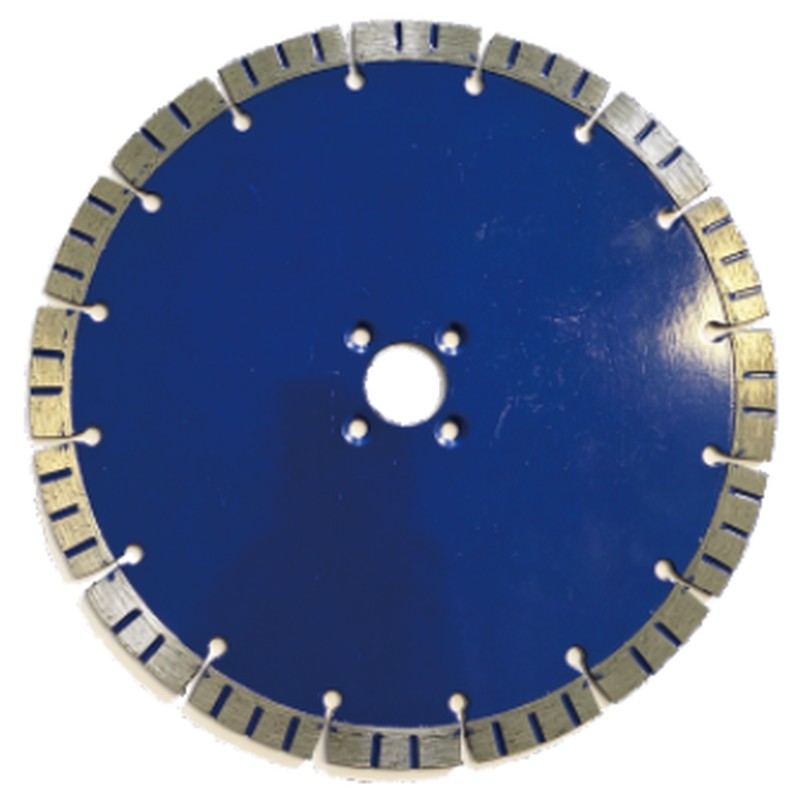
Yes, a turbo rim blade is an excellent general-purpose choice for fast masonry cutting — brick, block, tile and light concrete. The turbo rim has a serrated, notched edge that cuts faster than a continuous rim and smoother than a segmented blade, with good chip clearance. Choose a turbo blade in a medium-hard bond for masonry: it clears dust fast, cuts clean edges, and works wet or dry. For very abrasive materials (hard block, AAC), step up the feed or choose a softer bond.
| Blade | Speed | Edge Finish | Best For |
|---|---|---|---|
| Turbo rim | Fast | Clean | Masonry, tile, light concrete |
| Segmented | Fastest | Rougher | Heavy concrete, slab, rebar |
| Continuous rim | Slower | Cleanest | Tile, porcelain, glass |
The turbo rim is a continuous rim with a notched, serrated edge. The notches act like small teeth — they bite faster than a smooth continuous rim, while the continuous base keeps the cut smoother than segmented gaps. On brick and block, this means fast cuts with clean, chip-free edges, wet or dry.
Our general-purpose turbo dry blade handles brick, block and tile on grinders and cutters, while the universal stone blade covers mixed jobs with one disc.
A>Segmented is marginally faster on brick, but turbo gives a cleaner edge. For most masonry, turbo is the best balance.
A>Light concrete, yes. Thick reinforced slabs need a segmented laser-welded blade.
A>Both. Dry turbo blades have a slightly softer bond for cooling; wet cutting works too.
A>A 115-125 mm turbo blade in a medium bond — fast and clean.
Turbo rim blades are the best all-round masonry cutter — fast, clean and versatile. Browse our turbo blade range for grinders, cutters and saws.
