

Blade RPM Rating Mismatch: What Happens on a Faster Saw
Blade RPM Rating Mismatch: What Happens on a Faster Saw
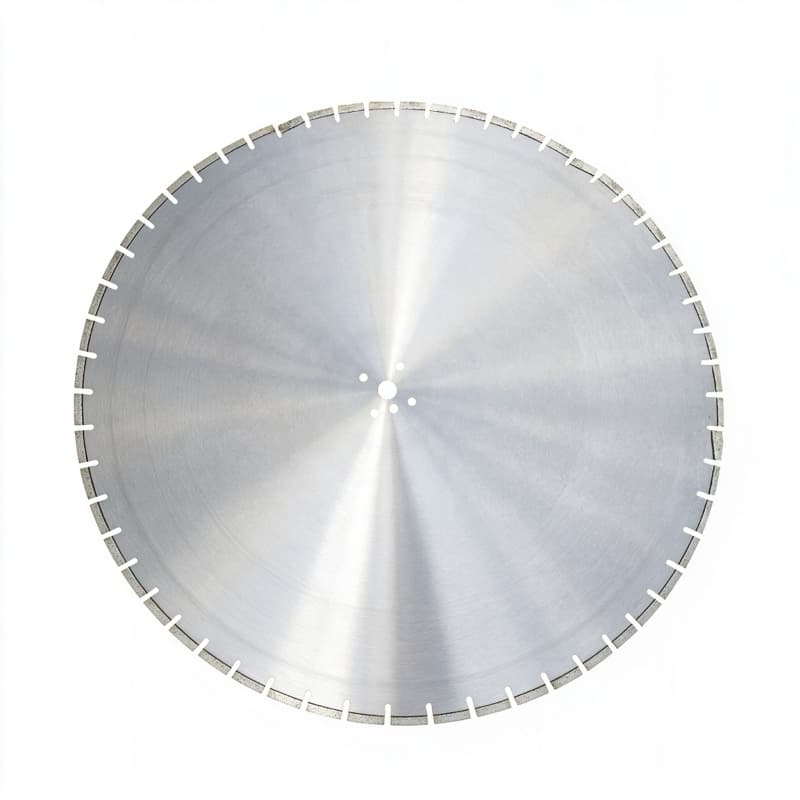
Quick Answer
A blade rated for a lower RPM must never run on a saw whose no-load speed exceeds that rating. Overspeed increases centrifugal load on the core, can crack or throw a segment, and voids the blade’s safety margin. Match the blade’s maximum RPM to the saw’s no-load RPM, not to the working RPM under load.
What the RPM Rating Means
The maximum RPM marked on a diamond blade is the highest speed at which the blade can safely run with its core and segment joint intact. It is not a performance recommendation; it is a structural limit. A 300 mm blade rated at 6,400 rpm has a lower rim speed than a 400 mm blade at the same RPM, which is why larger blades are rated lower.
The saw’s no-load speed is the speed with the trigger fully open and no load. That is the number to compare. A saw that slows to 8,000 rpm under load may still spin to 11,000 rpm when the blade exits the cut.
What Happens at Overspeed
- Core stress: the steel core sees centrifugal load proportional to RPM squared. A 20% overspeed adds about 44% more stress.
- Segment loss: the weld or braze is loaded in shear; a cracked segment can leave the blade at speed.
- Vibration: the blade can go out of balance and drum, which increases runout and cut width.
- Heat: higher rim speed generates more friction in the kerf and can overheat the segment.
- Warranty and liability: running a blade above its rating voids the manufacturer’s warranty and transfers the risk to the operator.
Common Mismatch Scenarios
The most common mismatch is a large blade on a small high-speed saw. A 350 mm blade rated at 5,500 rpm on a 4,000 rpm saw is safe; the same blade on a 6,000 rpm saw is overspeed. Another common case is a thin kerf blade rated for a low-speed tile saw used on a high-speed angle grinder.
| Saw type | Typical no-load RPM | Blade requirement |
|---|---|---|
| Hand-held angle grinder 125 mm | 11,000-13,000 | Blade rated 13,000+ |
| Hand-held angle grinder 230 mm | 6,000-6,600 | Blade rated 6,600+ |
| Walk-behind floor saw 350-450 mm | 3,000-4,000 | Blade rated 4,000+ |
| Tile saw 200-250 mm | 3,000-5,000 | Blade rated 5,000+ |
How to Check Before Mounting
Read the blade label and the saw nameplate. If the blade’s maximum RPM is lower than the saw’s no-load RPM, do not mount it. If the label is worn off, treat the blade as unknown and do not use it on a saw above the lowest common rating. Check the blade diameter and arbor match as well; a bushing that slips can let the blade spin off-axis.
Correcting a Mismatch
You have three options: use a smaller blade rated for the saw speed, use a slower saw, or use a blade specifically rated for the higher speed. Do not “fix” the problem by running the saw at part throttle; a variable-speed saw may still overspeed when the load drops. A governor or a mechanical speed limit is the only reliable control.
Frequently Asked Questions
Q: Can I run a 5,500 rpm blade on a 6,000 rpm saw?
A: No. The saw’s no-load speed exceeds the blade rating. Use a blade rated for at least 6,000 rpm.
Q: Does water or load reduce the risk?
A: No. Overspeed is a structural limit; load and water do not restore the safety margin.
Q: What happens if a segment comes off at speed?
A: It becomes a high-energy projectile. The guard and operator position may not contain it. This is why the RPM rating is a hard limit.
Q: Are all blades marked with RPM?
A: Quality blades are. If the marking is missing or unreadable, do not use the blade on a high-speed saw.
Conclusion
Match the blade’s maximum RPM to the saw’s no-load RPM every time. Overspeed is not a performance tweak; it is a structural and safety failure. JOY TECH supplies laser-welded concrete and asphalt blades and high-horsepower blades with clear speed ratings for the saw they are designed to run on.
Products used in this guide
Diamond Segment for Multi-Blade (Ganged Saw) — JOY-MB-S
View specs →
ARIX Ordered-Segment Diamond Ring Saw Blade (JOY-ARX-RS)
View specs →
Granite Saw Blade (Long Segment) — JOY-GR-L
View specs →Need this tool for your job?
MOQ 1 · 7–30 days by order quantity · FOB & CIF · free sample on request
Author & Manufacturer
Written and reviewed by JOY TECH — an SGS & BV audited, CE/RoHS certified diamond tools manufacturer founded in 2004, exporting to 50+ countries.
Quality & Compliance
Our factory and QMS are audited by SGS and Bureau Veritas. Products meet CE/RoHS requirements and every piece is 100% inspected before packing.
Verified Certificates
- SGS Audited Supplier — Report No. QIP-ASI227442 & QIP-ASR247051 (Audit Jan 29, 2024)
- Bureau Veritas Verified — Report No. MIC-ASR257059 (Audit Feb 20, 2025)
- CE & RoHS Certificate of Conformity — No. CS240925001HRZ (Issue Sep 25, 2024)